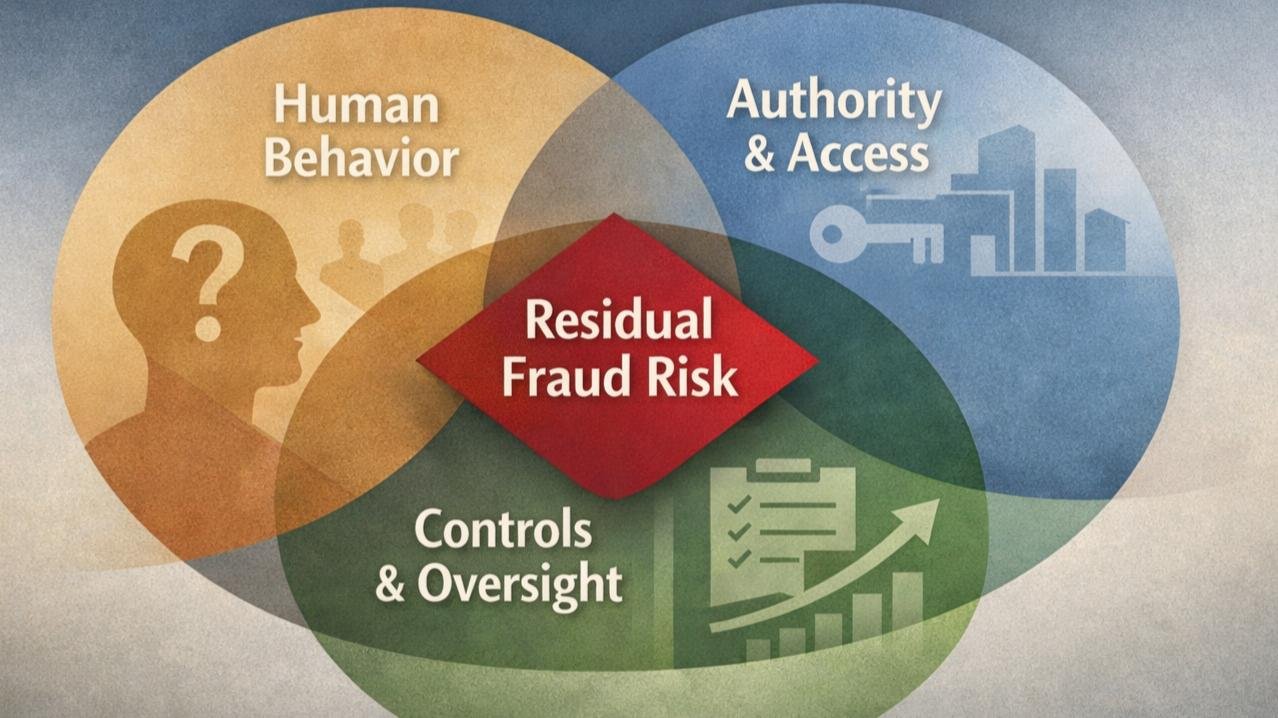
Fraud warning signs can help organizations identify unusual activity, control weaknesses and potential areas of fraud risk. Fraud can occur in almost any organization, regardless of its size, industry or financial position. It may involve employees, management, customers, suppliers, contractors or other parties connected with the organization.
In many cases, fraud does not begin with an obvious theft or a clearly suspicious transaction. It may be preceded by warning signs such as unusual transactions, unexplained financial changes, weaknesses in internal controls, altered documents, conflicts of interest or behaviour that does not fit normal business patterns.
These warning signs are often referred to as fraud red flags or fraud indicators.
Recognizing these indicators can help organizations identify areas that require closer attention and strengthen controls before losses become significant.
However, an important distinction should always be maintained:
A fraud red flag is not proof that fraud has occurred.
An unusual transaction, an employee’s behaviour or a control weakness may have a legitimate explanation. Red flags should therefore be treated as indicators that warrant appropriate review, investigation or escalation rather than as evidence of wrongdoing by themselves.
This guide explains more than 50 common fraud warning signs across transactions, financial information, employees, management, internal controls and organizational processes. It also explains what organizations can do when potential indicators are identified.
Why Fraud Red Flags Matter
Effective fraud prevention is not simply about identifying fraudulent transactions after they occur. It also involves understanding where vulnerabilities exist and recognizing circumstances that may increase the risk of fraud.
A single warning sign may have little significance. Several indicators occurring together, particularly when they involve financial transactions, documentation, control weaknesses or unusual behaviour, may justify a more detailed review.
Organizations should therefore consider fraud indicators as part of a broader risk-management process involving:
- Strong internal controls
- Appropriate segregation of duties
- Effective supervision
- Transaction monitoring
- Reconciliations and independent reviews
- Clear authorization procedures
- Reliable documentation and audit trails
- Employee awareness and reporting mechanisms
- Timely investigation of unusual activity
The objective is not to assume that suspicious-looking activity is fraudulent. The objective is to identify unusual circumstances early, understand why they occurred and take appropriate action when necessary.
1. Business & Organizational Warning Signs
Fraud risk is often influenced by the environment in which an organization operates. Weak governance, poor oversight, financial pressure and ineffective processes can create opportunities for fraud or make existing problems more difficult to detect.
The following organizational warning signs do not establish that fraud is taking place. Instead, they identify circumstances where management, internal audit, compliance teams or other responsible functions may need to examine the underlying causes more closely.
1.1 Weak Management Oversight
When management does not adequately review operations, financial information or employee activities, control weaknesses can remain undetected.
Warning signs may include:
- Important decisions being made without appropriate review or challenge
- Management relying heavily on a small number of individuals
- Significant transactions receiving limited scrutiny
- Exceptions being routinely ignored or approved without adequate explanation
- Management failing to follow up on known control weaknesses
Effective oversight does not mean reviewing every transaction personally. It means ensuring that appropriate controls, reporting lines and independent checks are actually working.
1.2 Excessive Concentration of Responsibility
Fraud risk can increase when one person has control over several stages of a transaction or process.
For example, an individual who can initiate a transaction, approve it, record it and reconcile the related account may have an opportunity to conceal an unauthorized transaction.
This is why segregation of duties is an important preventive control.
Particular attention may be appropriate where:
- One employee controls several incompatible functions
- System access gives an individual unusually broad authority
- Temporary arrangements continue for an extended period
- Key responsibilities are concentrated with one employee without independent review
1.3 Poor Segregation of Duties
Segregation of duties is designed to prevent one individual from having excessive control over a transaction from beginning to end.
Weaknesses may arise when the same person can:
- Create and approve transactions
- Maintain records and perform reconciliations
- Handle cash and maintain the accounting records
- Add or modify beneficiaries and authorize payments
- Maintain inventory records and physically control inventory
Where staffing limitations make complete segregation difficult, compensating controls such as independent review, supervisory approval and periodic reconciliation become particularly important.
1.4 High Employee Turnover in Sensitive Areas
Unusually high staff turnover can sometimes indicate underlying operational or management problems.
This may be particularly relevant in departments responsible for:
- Cash handling
- Procurement
- Finance and accounting
- Payments
- Customer accounts
- Inventory
- Operations
- Compliance or control functions
Turnover alone is not evidence of fraud. However, repeated departures from the same department may warrant examination of workload, management practices, employee concerns, control weaknesses and unresolved operational issues.
1.5 Lack of Independent Challenge
An organization can become vulnerable when employees or managers are reluctant to question unusual decisions.
Warning signs may include:
- Important decisions being accepted without adequate documentation
- Employees being discouraged from raising concerns
- Repeated exceptions being treated as normal
- Senior personnel receiving limited independent challenge
- Internal audit or compliance findings not receiving appropriate attention
A healthy control environment allows employees to raise concerns without fear of retaliation and expects significant decisions to withstand reasonable scrutiny.
1.6 Weak Record-Keeping and Audit Trails
Incomplete records can make it difficult to establish what happened, who authorized an action and whether a transaction was legitimate.
Potential warning signs include:
- Missing supporting documents
- Incomplete approval records
- Unexplained changes to accounting entries
- Transactions without clear business justification
- Poorly maintained registers
- Missing system logs or audit trails
- Repeated reliance on informal instructions instead of documented approvals
Good documentation does not prevent every fraud, but it makes unauthorized activity more difficult to conceal and easier to investigate.
1.7 Unusual Changes in Business Performance
Unexpected changes in financial or operational performance can sometimes warrant further analysis.
Examples include:
- Revenue changing significantly without a clear business explanation
- Profit margins moving sharply from historical patterns
- Expenses increasing disproportionately to business activity
- Unusual movements in receivables or payables
- Inventory levels changing significantly without corresponding changes in sales
- Large unexplained adjustments near the reporting date
Such changes can have legitimate commercial explanations. Seasonal effects, changes in pricing, economic conditions or business expansion should therefore be considered before treating them as potential fraud indicators.
1.8 Financial Pressure on the Organization
Financial difficulties can increase pressure on management or employees and may create incentives for inappropriate financial reporting or unauthorized activity.
Warning signs may include:
- Persistent cash-flow problems
- Difficulty meeting financial obligations
- Pressure to meet lending or contractual requirements
- Significant losses over an extended period
- Pressure to achieve aggressive financial targets
- Repeated delays in payments to suppliers or employees
Financial pressure does not mean that fraud will occur. It simply represents a circumstance that may justify stronger monitoring and review.
1.9 Significant Unexplained Changes in Business Processes
Unexpected changes to established procedures can create control gaps.
Examples include:
- New payment procedures introduced without adequate controls
- Changes to system access without proper authorization
- Established approval processes being bypassed
- Important controls being suspended for operational convenience
- Manual workarounds becoming permanent
- Changes to vendors, payment channels or account details without appropriate review
Process changes should be properly documented, authorized and assessed for their impact on existing controls.
1.10 Weak Governance or Limited Board Oversight
Organizations are more exposed to risk when governance structures do not provide effective oversight of management and significant business activities.
Potential warning signs include:
- Infrequent review of major risks
- Limited challenge of management decisions
- Significant control issues remaining unresolved
- Lack of follow-up on audit findings
- Related-party matters receiving inadequate scrutiny
- Major transactions receiving insufficient independent review
Strong governance helps ensure that management decisions are subject to appropriate accountability and oversight.
1.11 A Culture of Ignoring Exceptions
One of the more important organizational warning signs is when exceptions gradually become accepted as normal practice.
For example, an organization may repeatedly allow:
- Approvals after transactions have already occurred
- Missing supporting documents
- Unreconciled balances
- Manual adjustments without adequate explanation
- Policy exceptions without documented justification
- Repeated overrides of system controls
A single exception may be understandable. A pattern of unexplained exceptions is more significant because it can indicate that the control environment is not operating as intended.
1.12 Poor Response to Previous Control Findings
Repeated findings from internal audit, external audit, compliance reviews or other independent assessments should not simply be recorded and forgotten.
A warning sign may exist when:
- The same control deficiency appears repeatedly
- Management actions are continually delayed
- Agreed corrective actions are not implemented
- Responsibility for remediation is unclear
- Significant findings are repeatedly closed without resolving the underlying issue
Effective organizations do not merely identify control weaknesses—they track them through to resolution.
A Practical Approach
When several organizational warning signs appear together, management should avoid jumping directly to a conclusion of fraud.
Instead, a structured review can ask:
- What has changed?
- When did the change occur?
- Who is responsible for the affected process?
- What controls should have detected or prevented the issue?
- Are those controls operating effectively?
- Is there a legitimate business explanation?
- What supporting records are available?
- Does the issue appear isolated or part of a wider pattern?
This approach helps distinguish genuine business problems, control weaknesses and potentially fraudulent activity while reducing the risk of making unsupported accusations.
Key takeaway: A weak control environment does not prove fraud, but it can increase the opportunity for fraud and make irregularities harder to detect. Organizations should therefore treat persistent control weaknesses, unexplained changes and ineffective oversight as matters requiring timely attention.
2. Management Red Flags
Management plays a critical role in establishing an organization’s control environment. Senior managers have the authority to approve transactions, allocate resources, influence employees and make exceptions to established procedures.
That authority also means that inappropriate management actions can create significant fraud risk.
Management-related warning signs should therefore be considered carefully, particularly when they occur alongside unusual transactions, weak documentation or other control deficiencies.
2.1 Management Override of Established Controls
Controls are designed to operate consistently, but management may sometimes have the authority to override them for legitimate business reasons.
The warning sign arises when overrides become frequent, poorly documented or difficult to explain.
Examples include:
- Approving transactions outside established limits
- Bypassing required authorization
- Instructing employees to process transactions without normal documentation
- Overriding system controls
- Regularly approving exceptions after the transaction has already occurred
- Directing staff to ignore established procedures
A legitimate emergency may require an exception. The important question is whether the exception was properly authorized, documented and subsequently reviewed.
2.2 Excessive Secrecy Around Business Decisions
Confidentiality is necessary for some business activities. However, excessive secrecy surrounding routine transactions or decisions can make independent review difficult.
Potential warning signs include:
- Refusal to explain the business purpose of significant transactions
- Restricting information without a legitimate need
- Preventing appropriate staff from accessing records required for their duties
- Discouraging questions about unusual transactions
- Maintaining important arrangements outside normal reporting channels
The concern is not confidentiality itself, but secrecy that prevents appropriate oversight.
2.3 Pressure to Achieve Unrealistic Targets
Strong performance expectations are common in business. However, excessive pressure to achieve financial or operational targets can create incentives for inappropriate behavior.
Examples may include pressure to:
- Meet unrealistic revenue targets
- Report results that do not reflect actual performance
- Reduce expenses without regard to controls
- Complete transactions before reporting deadlines
- Avoid recognizing losses or problems
- Present a more favorable financial position than the underlying records support
Target pressure should therefore be considered alongside unusual accounting entries, unexplained adjustments or other financial anomalies.
2.4 Management Bypassing Subordinates or Normal Reporting Lines
Established reporting structures help ensure accountability and appropriate review.
A warning sign may arise when senior managers repeatedly bypass responsible employees and directly instruct staff to perform sensitive activities.
For example, a manager might directly instruct an employee to:
- Process a payment
- Change customer information
- Modify accounting records
- Release assets
- Alter established procedures
- Approve an exception
without involving the employee’s normal supervisor or control function.
Such activity may have legitimate reasons, but repeated bypassing of normal reporting channels deserves attention.
2.5 Subordinates Bypassing Management
The opposite situation can also create risk.
Employees may sometimes circumvent their managers or established approval structures to process transactions or make decisions independently.
Potential examples include:
- Employees approving transactions outside their authority
- Staff creating unauthorized workarounds
- Transactions being processed without required supervisory approval
- Employees maintaining separate records outside the organization’s official systems
This may indicate a control weakness even where no fraud is ultimately established.
2.6 Conflicts of Interest
A conflict of interest can arise when a person’s personal or financial interests overlap with their organizational responsibilities.
Potential warning signs include:
- A manager influencing the selection of a supplier with whom they have a personal connection
- Transactions involving businesses connected to management
- Undisclosed relationships with customers, suppliers or contractors
- Decisions that consistently benefit a particular external party
- Employees participating in decisions involving their own financial interests
Conflicts should be properly disclosed, assessed and managed through established policies.
A conflict of interest does not itself prove fraudulent conduct. The key issue is whether the relationship was disclosed and whether appropriate controls were applied.
2.7 Unusual Generosity or Preferential Treatment
Repeatedly giving unusual concessions to particular customers, suppliers or employees may warrant review.
Examples could include:
- Unusual discounts
- Waiver of fees without documented justification
- Preferential payment arrangements
- Repeated extensions of credit
- Exceptions granted to the same party
- Contract terms that appear inconsistent with normal business practice
The appropriate review should establish the commercial rationale and confirm that the decision was properly authorized.
2.8 Resistance to Independent Review
Management should generally be able to explain significant decisions and provide supporting documentation to authorized reviewers.
Potential warning signs include:
- Resistance to internal audit
- Delays in providing records
- Attempts to restrict legitimate review
- Repeated challenges to routine control testing
- Failure to respond adequately to significant findings
- Pressure on reviewers to modify or withdraw observations
Disagreement with an audit finding is not itself suspicious. Organizations should have appropriate mechanisms for management to challenge findings. The concern arises when legitimate independent review is obstructed without reasonable justification.
2.9 Unusual Changes in Management Behaviour
A significant and unexplained change in a manager’s normal working pattern may sometimes be relevant when combined with other indicators.
Examples might include:
- Becoming unusually secretive about routine activities
- Taking unusual control over records
- Avoiding normal delegation
- Becoming highly protective of particular transactions
- Spending excessive time on one sensitive area
- Showing unusual concern about audits or reconciliations
Behavioural changes should never be interpreted in isolation. There may be perfectly legitimate personal or professional reasons for them.
2.10 Excessive Control Over Records or Information
One potential warning sign is when a manager insists on personally controlling records that would normally be accessible to several authorized employees.
Examples include:
- Refusing to allow appropriate staff access to records
- Personally maintaining key accounting or operational records
- Removing records from normal custody
- Preventing independent reconciliation
- Controlling access to systems beyond the requirements of the role
This becomes more significant when the restricted information relates to transactions that are already attracting attention.
2.11 Failure to Take Action on Known Problems
Management may become aware of control weaknesses through audits, complaints, reconciliations, incident reports or employee concerns.
A warning sign may arise when significant issues are repeatedly ignored.
Examples include:
- Known irregularities not being investigated
- Repeated audit findings remaining unresolved
- Suspicious transactions not receiving appropriate review
- Control breaches becoming routine
- Management accepting unexplained discrepancies without adequate follow-up
Failure to act does not establish fraudulent intent, but it can substantially weaken the organization’s ability to prevent or detect misconduct.
2.12 Unclear or Excessive Delegation of Authority
Delegation is necessary in large organizations, but authority should be clearly defined and monitored.
Warning signs may include:
- Employees exercising authority beyond their approved limits
- Managers granting broad authority without adequate controls
- Delegations that are not documented
- Delegations remaining active after an employee changes roles
- Temporary authority becoming permanent without formal approval
Clear delegation helps establish who can make decisions and who is accountable for them.
Management Red Flags Should Be Considered Together
No single management behavior should automatically be treated as evidence of fraud.
The greater concern arises when management behavior combines with other indicators—for example, a manager repeatedly overrides controls while restricting access to records and approving unusual transactions involving a connected party.
In such circumstances, an organization should focus on facts, documentation, transaction history and control evidence, rather than assumptions about an individual’s intentions.
A structured review should establish what happened, who authorized it, whether the action complied with policy and whether there is a reasonable business explanation.
Key takeaway: Management authority is necessary for organizations to function, but excessive control, unexplained overrides, conflicts of interest, secrecy and resistance to independent review can create vulnerabilities that deserve appropriate scrutiny.
3. Employee-Related Red Flags
Employees working in finance, operations, cash handling, procurement, customer service and technology may have access to money, records, systems or assets. Changes in their work patterns can therefore be relevant when assessing fraud risk.
The following indicators are most useful when they represent a significant departure from an employee’s normal pattern or occur alongside unusual transactions or control exceptions.
3.1 Unusual Secrecy About Work
An employee becoming unusually protective of routine work may deserve attention, particularly when others previously had normal visibility of the process.
Examples include:
- Refusing to explain routine procedures
- Keeping important records exclusively under personal control
- Becoming unusually protective of particular accounts or transactions
- Avoiding normal handovers
- Preventing colleagues from performing routine checks
3.2 Reluctance to Take Leave
Employees in sensitive positions should generally be able to take leave without the underlying process becoming dependent on them.
Persistent reluctance to take leave can be relevant where an individual independently manages:
- Reconciliations
- Cash
- Payments
- Customer accounts
- Accounting records
- System administration
Regular rotation, leave arrangements and independent review can help expose problems that might otherwise remain hidden.
3.3 Unusual Working Hours or System Activity
Activity outside normal working patterns can become relevant when it involves financial systems, sensitive records or transactions.
Examples include:
- Repeated late-night system access
- Weekend processing without an apparent operational requirement
- Unusual activity immediately before or after reporting dates
- Access to accounts unrelated to the employee’s responsibilities
System logs can establish whether such activity actually occurred and what actions were performed.
3.4 Excessive System Access
Employees should normally have access appropriate to their roles.
Potential warning signs include:
- Access to unrelated customer or employee accounts
- Retention of access after a transfer
- Attempts to obtain unnecessary administrative privileges
- Use of another employee’s credentials
- Repeated access to sensitive information without a clear business need
Periodic user-access reviews are particularly important when employees change roles.
3.5 Bypassing Procedures
Operational shortcuts can gradually become accepted practice and weaken important controls.
Examples include:
- Processing transactions before obtaining required approval
- Using unofficial records instead of the approved system
- Circumventing system restrictions
- Obtaining retrospective approvals as a routine practice
- Ignoring documentation requirements
Repeated procedural bypasses should be distinguished from occasional operational exceptions.
3.6 Unexplained Financial Pressure
Financial difficulties can sometimes be relevant to fraud-risk assessments, especially for employees with direct access to cash, payments or financial records.
Possible indicators include:
- Repeated requests for advances
- Frequent borrowing from colleagues
- Persistent personal creditors contacting the workplace
- Significant unexplained financial pressure
Financial difficulty is common and, by itself, says nothing about whether an employee has committed misconduct. Its relevance depends on the person’s role and the presence of other objective indicators.
3.7 Significant Unexplained Lifestyle Changes
A substantial and unexplained change in apparent financial circumstances may attract attention where an employee occupies a sensitive position.
Examples might include spending or asset changes that appear inconsistent with known circumstances.
This is a particularly weak indicator when considered alone because organizations rarely have complete information about an employee’s legitimate income, investments, family circumstances or assets. It should therefore never substitute for examination of financial or transaction records.
3.8 Unusual Interest in Particular Customers or Transactions
An employee repeatedly seeking involvement in a particular account, customer, supplier or transaction may warrant review.
Relevant questions include:
- Is the activity part of the employee’s normal responsibilities?
- Why is the employee seeking involvement?
- Is there a personal or business relationship?
- Are transactions within approved limits?
- Does the documentation support the activity?
3.9 Undisclosed Conflicts of Interest
Employees may have personal relationships or financial interests involving customers, suppliers or other business counterparties.
Potential indicators include:
- Participation in decisions involving a related party
- Repeated dealings with a particular supplier
- Undisclosed personal relationships with customers or vendors
- Influence over procurement or payments benefiting an associated party
Organizations should maintain appropriate conflict-of-interest disclosure and review processes.
3.10 Covering Up Errors
Honest mistakes are inevitable in complex organizations. The greater concern is a pattern of concealing or altering errors rather than reporting them.
Examples include:
- Changing records without an appropriate audit trail
- Destroying or withholding supporting documents
- Concealing reconciliation differences
- Giving inconsistent explanations for an error
- Repeatedly shifting responsibility without resolving the underlying issue
The distinction between error and deliberate concealment should be established through evidence.
3.11 Unusual Absence Patterns
Changes in attendance may become relevant when they repeatedly coincide with specific operational events.
For example, repeated absences around:
- Reconciliations
- Cash counts
- Audits
- Inventory checks
- Transaction investigations
may warrant examination of the underlying process and records.
Attendance alone should not be treated as evidence of wrongdoing.
3.12 Excessive Dependence on One Employee
A process becomes vulnerable when only one employee knows how it operates or controls the relevant information.
Warning signs include:
- No effective backup arrangement
- Procedures existing only as personal knowledge
- Records that cannot be independently reconciled
- Other employees being unable to perform basic tasks in the individual’s absence
- Important activities being performed outside documented procedures
This is both a continuity risk and a potential fraud-risk issue.
3.13 Persistent Refusal to Follow Established Rules
Occasional disagreements with procedures are normal. A repeated pattern of deliberately ignoring important requirements is more significant.
Examples include:
- Refusing mandatory approval requirements
- Repeatedly ignoring security procedures
- Disregarding customer-identification requirements
- Continuing unauthorized work practices after being instructed to stop
- Treating important control requirements as optional
3.14 Personal Problems Affecting Sensitive Responsibilities
Significant personal circumstances can sometimes affect an employee’s ability to perform a sensitive role.
Organizations should avoid intrusive assumptions and instead focus on whether there is an identifiable impact on:
- Access to assets
- Cash handling
- Financial decision-making
- System access
- Compliance with procedures
- Reliability of key controls
Where necessary, appropriate management or HR processes should address the issue rather than relying on informal judgments.
What Matters Most
Employee-related indicators become more meaningful when they connect to specific business activity.
For example, an employee working unusual hours is not necessarily concerning. Unusual hours combined with unexplained system access, transactions outside normal authority and missing supporting documentation provide a substantially different situation for review.
The focus should therefore remain on the relationship between employee activity, transaction evidence and control requirements.
Key takeaway: Changes in employee behavior can provide useful risk signals, but objective evidence from transactions, system records, documentation and controls should form the foundation of any further review.
4. Internal Control Weaknesses
Fraud often becomes easier to commit or conceal when important controls are missing, poorly designed or not operating as intended.
Control weaknesses can occur in accounting, payments, procurement, inventory, cash management, information systems and other operational processes. The following areas deserve particular attention when assessing an organization’s exposure to fraud risk.
4.1 Inadequate Segregation of Duties
Important responsibilities should be divided so that one person does not have excessive control over a transaction.
Risk can increase when the same individual can:
- Initiate a transaction
- Approve it
- Record it
- Handle the related asset or funds
- Reconcile the resulting balance
Where staffing constraints prevent full segregation, independent review or other compensating controls should be considered.
4.2 Weak Authorization Controls
Transactions should be approved by individuals with appropriate authority and within clearly defined limits.
Warning signs include:
- Missing approvals
- Approvals obtained after transactions are processed
- Repeated overrides of approval limits
- Unclear delegation arrangements
- Approvals that cannot be independently verified
- Transactions processed under expired or inappropriate authority
4.3 Poor Reconciliation Practices
Reconciliations help identify differences between records and actual balances.
Weaknesses may include:
- Bank accounts not reconciled regularly
- Long-outstanding reconciling items
- Suspense accounts containing unexplained balances
- Reconciliations prepared but not independently reviewed
- Differences carried forward without resolution
- Repeated adjustments used to clear unexplained discrepancies
A reconciliation that is prepared but not properly investigated can provide a false sense of control.
4.4 Inadequate Physical Controls Over Assets
Physical assets should be appropriately safeguarded and periodically verified.
Potential weaknesses include:
- Infrequent inventory counts
- Poor control over valuable items
- Missing asset registers
- Differences between physical and accounting records
- Unrestricted access to warehouses or storage areas
- Assets being transferred without documentation
These weaknesses can make unauthorized removal or substitution more difficult to detect.
4.5 Weak Cash Controls
Cash is particularly vulnerable because it can be moved or used immediately.
Control weaknesses may include:
- Excessive cash held at operating locations
- Infrequent cash counts
- Poor custody arrangements
- Personal funds mixed with organizational cash
- Petty cash without adequate supporting documents
- Multiple collection points without effective reconciliation
- Cash differences not investigated promptly
4.6 Inadequate Documentation
A transaction should normally have sufficient documentation to establish its purpose, authorization and supporting evidence.
Warning signs include:
- Missing vouchers
- Incomplete invoices
- Unavailable original documents
- Altered records without an audit trail
- Repeated use of photocopies where originals are expected
- Supporting documents prepared after the transaction
- Inconsistent dates, amounts or signatures
Documentation weaknesses can affect both fraud prevention and the ability to investigate incidents.
4.7 Weak Access Controls
System access should be based on job responsibilities and reviewed regularly.
Potential weaknesses include:
- Shared user IDs
- Excessive privileges
- Former employees retaining access
- Inadequate password controls
- Lack of privileged-user monitoring
- Inability to determine who performed a particular transaction
- Inadequate review of changes to sensitive data
Strong access controls are especially important for systems handling payments, customer accounts and financial records.
4.8 Missing or Incomplete Audit Trails
An effective audit trail should make it possible to determine what happened, when it happened and who performed or authorized the activity.
A weak audit trail may result when:
- System changes are not logged
- Manual adjustments lack explanations
- Approval history cannot be retrieved
- Records can be deleted without trace
- Changes to master data are not monitored
- Important activities take place outside the organization’s systems
Without a reliable audit trail, both prevention and investigation become more difficult.
4.9 Weak Vendor and Procurement Controls
Procurement processes can be exposed where supplier selection, purchasing and payment responsibilities are not adequately controlled.
Warning signs include:
- Suppliers added without appropriate verification
- Inadequate competitive bidding
- Repeated awards to the same supplier without clear justification
- Purchases divided to avoid approval limits
- Payments made without evidence of receipt
- Vendor information changed without independent verification
Supplier due diligence and independent review are particularly important where significant amounts are involved.
4.10 Inadequate Customer or Counterparty Verification
Organizations may face additional risk when they do not adequately establish who they are dealing with.
Control weaknesses may include:
- Incomplete identification records
- Outdated customer information
- Insufficient verification of counterparties
- Uncontrolled changes to account details
- Weak review of beneficial ownership information where applicable
The appropriate requirements depend on the organization’s industry, regulatory obligations and risk profile.
4.11 Weak Exception Monitoring
Automated systems and operational processes often generate exception reports to identify unusual activity.
A control weakness exists when:
- Exception reports are not reviewed
- Repeated exceptions are routinely ignored
- Responsibility for follow-up is unclear
- Exceptions are closed without adequate explanation
- Management does not monitor recurring patterns
The value of an exception report depends on what happens after the exception is identified.
4.12 Poor Control Over Master Data
Changes to important standing information can affect many subsequent transactions.
Examples include:
- Customer account details
- Supplier bank accounts
- Employee payment information
- Product prices
- Credit limits
- User access rights
Weaknesses arise when such changes can be made without independent verification, approval or an appropriate audit trail.
4.13 Inadequate Independent Review
Some processes require a second level of review to detect errors or unauthorized activity.
Potential weaknesses include:
- Reviews performed by the same person who prepared the work
- Supervisory checks completed without evidence
- Reviews focused only on signatures rather than substance
- High-risk transactions receiving the same level of review as routine transactions
- Review findings not documented
An independent review should add meaningful challenge rather than simply confirm that a form has been completed.
4.14 Unresolved Control Deficiencies
A control weakness becomes more significant when management knows about it but does not address it within an appropriate timeframe.
Examples include:
- Repeated audit findings
- Long-standing reconciliation problems
- Known system-access weaknesses
- Repeated policy breaches
- Outstanding corrective actions
- Control failures that continue after previous incidents
Tracking deficiencies to resolution is an important part of an effective control framework.
4.15 Lack of Monitoring and Management Information
Organizations need appropriate information to identify unusual patterns and emerging risks.
Weak monitoring may mean that management does not receive timely information about:
- Unusual transaction volumes
- Significant adjustments
- Repeated exceptions
- Losses or write-offs
- Unreconciled balances
- Staff or system access anomalies
- Concentrations of activity involving particular customers or suppliers
Without suitable monitoring, individual irregularities may remain isolated and patterns may not become visible.
Why Control Weaknesses Matter
Fraud risk is not determined solely by whether an organization has policies written on paper. Controls must also be appropriately designed, consistently applied, independently reviewed and capable of detecting exceptions.
A process with several overlapping weaknesses—for example, weak authorization, poor reconciliation and excessive system access—may require more attention than any individual weakness considered separately.
Key takeaway: Effective internal controls reduce opportunities for unauthorized activity and increase the likelihood that irregularities will be detected promptly. Control weaknesses should therefore be identified, documented, prioritized and addressed rather than treated as routine operational issues.
4. Internal Control Weaknesses
Fraud often becomes easier to commit or conceal when important controls are missing, poorly designed or not operating as intended.
Control weaknesses can occur in accounting, payments, procurement, inventory, cash management, information systems and other operational processes. The following areas deserve particular attention when assessing an organization’s exposure to fraud risk.
4.1 Inadequate Segregation of Duties
Important responsibilities should be divided so that one person does not have excessive control over a transaction.
Risk can increase when the same individual can:
- Initiate a transaction
- Approve it
- Record it
- Handle the related asset or funds
- Reconcile the resulting balance
Practical red-flag example:
An employee can create a new supplier, approve a payment to that supplier and reconcile the bank account. A review identifies several payments to recently created suppliers with limited supporting documentation.
4.2 Weak Authorization Controls
Transactions should be approved by individuals with appropriate authority and within clearly defined limits.
Warning signs include:
- Missing approvals
- Approvals obtained after transactions are processed
- Repeated overrides of approval limits
- Unclear delegation arrangements
- Approvals that cannot be independently verified
- Transactions processed under expired or inappropriate authority
Practical red-flag example:
A series of payments just below an employee’s approval limit are processed over several days. Each transaction appears individually authorized, but the combined value is unusually large.
4.3 Poor Reconciliation Practices
Reconciliations help identify differences between records and actual balances.
Weaknesses may include:
- Bank accounts not reconciled regularly
- Long-outstanding reconciling items
- Suspense accounts containing unexplained balances
- Reconciliations prepared but not independently reviewed
- Differences carried forward without resolution
- Repeated adjustments used to clear unexplained discrepancies
Practical red-flag example:
A bank reconciliation repeatedly contains the same unexplained difference month after month, while temporary entries are used to make the balance appear reconciled.
4.4 Inadequate Physical Controls Over Assets
Physical assets should be appropriately safeguarded and periodically verified.
Potential weaknesses include:
- Infrequent inventory counts
- Poor control over valuable items
- Missing asset registers
- Differences between physical and accounting records
- Unrestricted access to warehouses or storage areas
- Assets being transferred without documentation
Practical red-flag example:
The inventory system shows 500 units of a high-value item, but a physical count finds significantly fewer units. Previous stock adjustments have also been made without adequate supporting records.
4.5 Weak Cash Controls
Cash is particularly vulnerable because it can be moved or used immediately.
Control weaknesses may include:
- Excessive cash held at operating locations
- Infrequent cash counts
- Poor custody arrangements
- Personal funds mixed with organizational cash
- Petty cash without adequate supporting documents
- Multiple collection points without effective reconciliation
- Cash differences not investigated promptly
Practical red-flag example:
A branch regularly reports small cash shortages that are individually written off as minor differences. Over time, the cumulative unexplained amount becomes significant.
4.6 Inadequate Documentation
A transaction should normally have sufficient documentation to establish its purpose, authorization and supporting evidence.
Warning signs include:
- Missing vouchers
- Incomplete invoices
- Unavailable original documents
- Altered records without an audit trail
- Repeated use of photocopies where originals are expected
- Supporting documents prepared after the transaction
- Inconsistent dates, amounts or signatures
Practical red-flag example:
Several payment files contain photocopied invoices, manually altered amounts and signatures that appear inconsistent with the approved signatory records.
4.7 Weak Access Controls
System access should be based on job responsibilities and reviewed regularly.
Potential weaknesses include:
- Shared user IDs
- Excessive privileges
- Former employees retaining access
- Inadequate password controls
- Lack of privileged-user monitoring
- Inability to determine who performed a particular transaction
- Inadequate review of changes to sensitive data
Practical red-flag example:
An employee transfers to another department but retains access to the previous department’s customer accounts. System logs subsequently show activity on those accounts outside the employee’s new responsibilities.
4.8 Missing or Incomplete Audit Trails
An effective audit trail should make it possible to determine what happened, when it happened and who performed or authorized the activity.
A weak audit trail may result when:
- System changes are not logged
- Manual adjustments lack explanations
- Approval history cannot be retrieved
- Records can be deleted without trace
- Changes to master data are not monitored
- Important activities take place outside the organization’s systems
Practical red-flag example:
A customer account balance changes significantly, but the system cannot establish which user made the adjustment or who authorized it.
4.9 Weak Vendor and Procurement Controls
Procurement processes can be exposed where supplier selection, purchasing and payment responsibilities are not adequately controlled.
Warning signs include:
- Suppliers added without appropriate verification
- Inadequate competitive bidding
- Repeated awards to the same supplier without clear justification
- Purchases divided to avoid approval limits
- Payments made without evidence of receipt
- Vendor information changed without independent verification
Practical red-flag example:
Three quotations are obtained for a purchase, but the same supplier repeatedly receives the contract even though its pricing or terms are not consistently the most competitive.
4.10 Inadequate Customer or Counterparty Verification
Organizations may face additional risk when they do not adequately establish who they are dealing with.
Control weaknesses may include:
- Incomplete identification records
- Outdated customer information
- Insufficient verification of counterparties
- Uncontrolled changes to account details
- Weak review of beneficial ownership information where applicable
Practical red-flag example:
A supplier requests a change to its bank account shortly before a large payment is due. The change is processed using an email request without independent verification through an established channel.
4.11 Weak Exception Monitoring
Automated systems and operational processes often generate exception reports to identify unusual activity.
A control weakness exists when:
- Exception reports are not reviewed
- Repeated exceptions are routinely ignored
- Responsibility for follow-up is unclear
- Exceptions are closed without adequate explanation
- Management does not monitor recurring patterns
Practical red-flag example:
A system repeatedly flags transactions above a defined threshold, but the same type of exception continues to be closed each month with generic explanations.
4.12 Poor Control Over Master Data
Changes to important standing information can affect many subsequent transactions.
Examples include:
- Customer account details
- Supplier bank accounts
- Employee payment information
- Product prices
- Credit limits
- User access rights
Weaknesses arise when such changes can be made without independent verification, approval or an appropriate audit trail.
Practical red-flag example:
A supplier’s bank account is changed immediately before a major payment, and the organization cannot demonstrate who requested, verified or approved the change.
4.13 Inadequate Independent Review
Some processes require a second level of review to detect errors or unauthorized activity.
Potential weaknesses include:
- Reviews performed by the same person who prepared the work
- Supervisory checks completed without evidence
- Reviews focused only on signatures rather than substance
- High-risk transactions receiving the same level of review as routine transactions
- Review findings not documented
Practical red-flag example:
A supervisor signs hundreds of transaction forms each day but there is no evidence that supporting documents, amounts or unusual exceptions were actually reviewed.
4.14 Unresolved Control Deficiencies
A control weakness becomes more significant when management knows about it but does not address it within an appropriate timeframe.
Examples include:
- Repeated audit findings
- Long-standing reconciliation problems
- Known system-access weaknesses
- Repeated policy breaches
- Outstanding corrective actions
- Control failures that continue after previous incidents
Practical red-flag example:
An internal audit report identifies weak user-access controls. Six months later, the same employees still have excessive access and no documented remediation has taken place.
4.15 Lack of Monitoring and Management Information
Organizations need appropriate information to identify unusual patterns and emerging risks.
Weak monitoring may mean that management does not receive timely information about:
- Unusual transaction volumes
- Significant adjustments
- Repeated exceptions
- Losses or write-offs
- Unreconciled balances
- Staff or system access anomalies
- Concentrations of activity involving particular customers or suppliers
Practical red-flag example:
Management reviews total monthly expenditure but does not receive information showing unusual increases in individual vendor payments, duplicate invoices or payments outside normal purchasing patterns.
Looking Beyond the Individual Red Flag
A control weakness becomes more meaningful when it connects to actual activity.
For example, weak segregation of duties alone may simply reflect a small organization’s staffing limitations. But if the same employee can create suppliers, approve payments and reconcile accounts—and unusual payments to newly created suppliers are subsequently identified—the combined circumstances deserve closer attention.
This is why fraud-risk reviews should look for patterns and connections between controls, transactions, people, systems and documentation, rather than treating every isolated weakness as evidence of fraud.
Key takeaway: Effective internal controls reduce opportunities for unauthorized activity and increase the likelihood that irregularities will be detected promptly. Practical testing should therefore examine not only whether a control exists, but whether it works in real transactions.
5. Transaction Red Flags
Transactions can provide some of the clearest evidence of unusual activity because they leave records that can be analyzed for patterns, timing, amounts, counterparties and frequency.
A transaction becomes a potential red flag when it is inconsistent with the customer’s, employee’s, supplier’s or organization’s normal activity, lacks a reasonable business purpose, or forms part of a broader unusual pattern.
5.1 Transactions Outside the Normal Pattern
A sudden change in the size, frequency or nature of transactions can warrant review.
Examples include:
- A customer suddenly receiving or sending much larger amounts than usual
- An account becoming active after a long period of inactivity
- A business making payments unrelated to its normal activities
- Transaction volumes changing sharply without an apparent business reason
Practical example:
An account historically used for routine business receipts suddenly begins receiving multiple large transfers from unrelated parties followed by rapid outward transfers.
5.2 Unusually Large or High-Value Transactions
Large transactions are not inherently suspicious. They become more relevant when they are inconsistent with the known profile or circumstances of the activity.
Review may be appropriate where:
- Amounts are significantly above historical levels
- Large payments have limited supporting documentation
- Transactions occur outside normal business activity
- Funds move through an account without an apparent economic purpose
5.3 Repeated Round-Amount Transactions
Repeated transactions involving unusually round amounts can sometimes warrant examination.
Examples include multiple transfers of:
- Rs. 500,000
- Rs. 1,000,000
- Rs. 2,000,000
particularly where the amounts have no obvious connection to invoices, contracts or other legitimate business activity.
Round amounts alone are weak evidence because legitimate payments are frequently made in round figures.
5.4 Split or Structured Transactions
A larger transaction may sometimes be divided into several smaller transactions.
Potential indicators include:
- Multiple transactions just below an approval threshold
- Several transfers made within a short period
- Payments divided between related accounts
- Purchases split into separate invoices without an obvious commercial reason
Practical example:
A payment requiring senior approval is divided into several smaller payments, each falling just below the approval limit, and processed within a short period.
5.5 Rapid Movement of Funds
Rapid movement of funds through an account can be relevant when the account appears to function mainly as a temporary channel.
Examples include:
- Funds received and transferred out shortly afterward
- Multiple incoming payments followed by consolidated outward transfers
- Balances remaining unusually low despite substantial transaction volumes
- Money moving through several connected accounts in quick succession
The underlying purpose and relationship between the parties should be established before drawing conclusions.
5.6 Frequent Transfers Between Related Accounts
Transfers between accounts belonging to the same customer, connected businesses or related individuals may have legitimate purposes.
However, repeated movement of funds between accounts can warrant review when:
- There is no clear business rationale
- Funds circulate through several accounts
- Transfers repeatedly reverse earlier transactions
- Different accounts appear to be used to avoid normal controls
- The movement obscures the original source or destination of funds
5.7 Unusual Third-Party Transactions
Transactions involving parties who are not normally connected with an account can be relevant.
Examples include:
- A business receiving frequent payments from unrelated individuals
- Personal accounts receiving substantial business-related funds
- Payments made by parties with no apparent connection to the underlying transaction
- Third parties regularly funding another person’s obligations
Practical example:
A business account normally receives customer payments, but a significant proportion of its receipts suddenly comes from unrelated personal accounts.
5.8 Unusual Cash Activity
Cash transactions may warrant additional attention when they are inconsistent with the nature or size of the business.
Potential indicators include:
- Sudden increases in cash deposits
- Frequent large cash withdrawals
- Cash activity inconsistent with the customer’s business model
- Multiple cash deposits made at different locations
- Repeated cash transactions followed by immediate transfers
The nature of the business should always be considered. Cash-intensive businesses naturally have higher cash transaction volumes.
5.9 Unusual Transaction Timing
Timing can sometimes reveal patterns that are not obvious from individual transactions.
Examples include transactions:
- Immediately before reporting dates
- Immediately after receiving funds
- Outside normal business hours
- Just before approval limits change
- Near the end of a financial period
- Immediately before or after an audit or review
Practical example:
Several significant accounting adjustments are posted on the final day of a reporting period and subsequently reversed shortly after the period closes.
5.10 Frequent Reversals or Cancellations
Repeated reversals can indicate operational problems or may warrant examination when the pattern is unusual.
Potential indicators include:
- Transactions repeatedly posted and reversed
- Payments cancelled shortly after approval
- Repeated corrections involving the same employee or account
- Reversals followed by transactions to different beneficiaries
- Unexplained adjustments after reconciliation
The objective should be to determine why the original transaction occurred and why it was subsequently reversed.
5.11 Transactions With Dormant or Inactive Accounts
Activity on an account that has been inactive for an extended period can warrant review.
Examples include:
- A dormant account suddenly receiving substantial funds
- Large transfers immediately after an account becomes active
- An inactive supplier becoming the recipient of significant payments
- Previously unused customer accounts becoming heavily transacted
5.12 Unusual Beneficiary or Account Changes
Changes to payment destinations can create significant risk.
Potential indicators include:
- A supplier’s bank account changing shortly before payment
- Customer account details being modified without normal documentation
- Multiple beneficiaries being added within a short period
- Payments redirected to accounts unrelated to previous transactions
Independent verification of important account-detail changes can significantly reduce this risk.
5.13 Transactions Involving Related Parties
Related-party transactions can be legitimate and are common in many businesses.
They deserve appropriate scrutiny when:
- Relationships are not properly disclosed
- Transactions occur outside normal commercial terms
- Pricing appears unusual
- Significant amounts are transferred without clear documentation
- The same related parties repeatedly benefit from exceptions
The key questions are whether the relationship was disclosed, whether the transaction has a legitimate purpose and whether appropriate approval was obtained.
5.14 Unusual Payments to Employees or Management
Payments to employees or management outside normal salary, benefits and approved expense arrangements may warrant review.
Examples include:
- Repeated advances that remain unsettled
- Unusual reimbursements
- Payments without supporting receipts
- Personal expenses charged to organizational accounts
- Payments made outside established payroll processes
5.15 Unusual Supplier Payments
Supplier payments can reveal patterns that deserve examination.
Examples include:
- Payments significantly exceeding contractual amounts
- Duplicate or near-duplicate invoices
- Payments made before goods or services are received
- Payments to suppliers with incomplete documentation
- Multiple payments for apparently identical services
- Significant increases in payments without corresponding business activity
5.16 Transactions Without a Clear Economic Purpose
A legitimate transaction should generally have an understandable business or personal purpose consistent with the account or activity.
Potential warning signs include:
- Funds moving between accounts without a clear explanation
- Payments unrelated to the stated nature of the business
- Transactions supported only by vague descriptions
- Complex transaction chains with no apparent commercial rationale
Where the purpose is unclear, the appropriate response is to establish the facts and supporting evidence.
5.17 Unusual Concentration of Transactions
A sudden concentration of activity involving one customer, supplier, beneficiary or account can be relevant.
For example:
- A supplier suddenly receives most of the organization’s procurement spend
- One customer accounts for an unusually large proportion of receipts
- Payments increasingly flow to a single beneficiary
- Multiple employees repeatedly transact with the same external party
Concentration may be commercially justified, but unexplained changes should be understood.
5.18 Transactions That Do Not Match Supporting Records
One of the most direct warning signs is a mismatch between the transaction and the documentation supporting it.
Examples include:
- Invoice amount different from payment amount
- Payment date inconsistent with the underlying contract
- Goods received differing from the quantity invoiced
- Customer instructions inconsistent with recorded transactions
- Accounting entries that cannot be reconciled to source documents
These discrepancies should be investigated promptly, particularly when they recur.
Look for Patterns, Not Just Individual Transactions
A single unusual transaction may have a perfectly legitimate explanation. Fraud-risk analysis becomes more meaningful when multiple indicators connect.
For example:
A supplier’s bank account is changed shortly before payment, several invoices are processed just below an approval threshold, and the same supplier receives an unusual increase in business.
Each event may have an explanation. Together, however, they create a pattern that deserves a more detailed review.
Transaction monitoring should therefore consider amount, frequency, timing, counterparties, account relationships, historical behavior and supporting documentation.
Key takeaway: Transaction red flags are most useful when analyzed in context. The objective is to identify unusual patterns and understand their underlying purpose—not to label individual transactions as fraudulent simply because they differ from normal activity.
Practical Transaction Review Checklist
When a transaction or transaction pattern appears unusual, a reviewer can use the following checklist to structure the initial review.
Transaction Review Checklist
| Review Area | Questions to Consider |
|---|---|
| Amount | Is the amount significantly different from normal activity? |
| Frequency | Are similar transactions occurring unusually often? |
| Timing | Did the transaction occur at an unusual time, such as near period-end or outside normal business hours? |
| Counterparty | Who is the other party, and is the relationship understood? |
| Purpose | Is there a clear and reasonable business or personal purpose? |
| Authorization | Was the transaction approved by the appropriate person? |
| Documentation | Are invoices, contracts, receipts or other supporting records available? |
| Account details | Have beneficiary, customer or supplier details recently changed? |
| Transaction pattern | Does the transaction form part of a larger series of related transactions? |
| Related accounts | Are connected accounts or parties involved? |
| Historical activity | Is the transaction consistent with previous activity? |
| Reconciliation | Does the transaction reconcile with the relevant accounting or operational records? |
| Exceptions | Has the transaction triggered a system, compliance or operational exception? |
| Explanation | Has the person responsible provided a reasonable and verifiable explanation? |
| Independent verification | Can the key facts be confirmed through an independent source or record? |
A Simple Three-Stage Review
For practical use, transaction reviews can be organized into three stages:
1. Identify
Determine what makes the transaction unusual.
2. Understand
Establish the purpose, parties involved, supporting documents and surrounding transaction history.
3. Validate
Verify the explanation against independent records and determine whether any control, compliance or reporting issue requires further action.
This approach helps reviewers move from an initial alert to a fact-based assessment without automatically treating an unusual transaction as fraudulent.
6. Financial Warning Signs
Financial information can reveal patterns that may indicate control problems, inaccurate reporting or potential fraud risk. Unusual movements in revenue, expenses, assets, liabilities or financial ratios can warrant further review—particularly when they are inconsistent with operational activity or supporting records.
A financial warning sign does not establish fraud. The purpose of financial analysis is to identify unusual patterns and determine whether there is a reasonable, well-supported explanation.
6.1 Unexplained Changes in Revenue
Significant changes in revenue should generally be consistent with business activity.
Potential warning signs include:
- Revenue increasing sharply without a corresponding increase in sales volume
- Significant revenue recorded near the end of a reporting period
- Revenue growth inconsistent with industry or operational trends
- Unusual increases followed by reversals or credit notes
- Sales recorded without adequate supporting documentation
Review should consider sales records, invoices, delivery evidence, customer confirmations and subsequent collections.
6.2 Declining Profitability Despite Stable or Increasing Revenue
Revenue growth does not necessarily mean the underlying business is improving.
A sustained decline in profitability may warrant examination when accompanied by:
- Rapid increases in operating expenses
- Unexplained cost increases
- Significant write-offs
- Unusual adjustments
- Changes in gross or net profit margins
The objective is to understand whether the changes reflect genuine business conditions or weaknesses in financial reporting and controls.
6.3 Unusual Changes in Gross or Net Profit Margins
Large changes in margins can provide useful analytical signals.
For example:
- Gross margin changes significantly without a clear change in pricing or costs
- One product or business unit reports margins substantially different from historical levels
- Profit margins differ significantly from operational expectations
- Margin improvements occur immediately before reporting dates
Margin analysis should be performed over time and, where appropriate, against budgets, forecasts and comparable business activity.
6.4 Unusual or Rapidly Increasing Expenses
Expenses that increase significantly without corresponding business activity may require review.
Examples include:
- Consultancy or professional fees
- Travel and entertainment
- Marketing expenses
- Repairs and maintenance
- Procurement costs
- Employee-related expenses
- Miscellaneous or other operating expenses
Particular attention may be appropriate where expenses are poorly documented or concentrated around a small number of suppliers.
6.5 Unusual Changes in Receivables
Accounts receivable can provide important information about the quality of reported revenue and cash collection.
Potential indicators include:
- Receivables increasing much faster than sales
- Long-outstanding balances increasing
- Significant balances concentrated with a few customers
- Repeated extensions of payment terms
- Receivables remaining unpaid despite reported strong profits
- Large balances subsequently written off
Receivables should be assessed alongside sales, customer confirmations, collections and credit terms.
6.6 Large or Unusual Bad-Debt Write-Offs
Significant write-offs may be legitimate, but unusual patterns should be understood.
Review may be appropriate where:
- Write-offs are significantly higher than historical levels
- Large balances are written off shortly after being recognized
- The same customers repeatedly generate bad debts
- Write-offs lack adequate approval or documentation
- Recoveries are inconsistent with the recorded status of the receivable
6.7 Unusual Inventory Movements
Inventory balances should generally be consistent with purchasing, production and sales activity.
Potential warning signs include:
- Inventory increasing despite declining sales
- Significant inventory adjustments
- Unusually high obsolete or damaged inventory
- Large differences between physical counts and accounting records
- Repeated shortages or unexplained losses
- Inventory held at unusual locations
Physical verification and reconciliation can help determine whether differences arise from operational issues, recording errors or other causes.
6.8 Unusual Asset Valuations or Adjustments
Changes in the value or classification of assets can affect reported financial results.
Review may be warranted for:
- Significant changes in asset valuations
- Unusual impairment adjustments
- Reclassification of expenses as assets
- Capital expenditure without clear evidence of the underlying asset
- Disposal of assets at unusual values
- Assets appearing in records but not being physically identifiable
6.9 Unusual Liabilities or Unrecorded Obligations
Financial statements may appear stronger when liabilities or obligations are not properly recognized.
Potential indicators include:
- Significant differences between supplier statements and recorded balances
- Unusual delays in recording expenses or liabilities
- Large payments made shortly after the reporting date
- Significant commitments not reflected in management reporting
- Unexplained changes in accrued expenses
Cut-off testing and review of subsequent payments can help identify potential issues.
6.10 Significant Period-End Adjustments
Large adjustments close to month-end, quarter-end or year-end can warrant additional scrutiny.
Examples include:
- Manual journal entries posted immediately before reporting deadlines
- Significant revenue adjustments
- Unusual expense reversals
- Large provisions or releases
- Entries with limited supporting documentation
- Adjustments that are reversed shortly after the reporting period
Period-end adjustments are not inherently improper. Their purpose, authorization and supporting evidence should be established.
6.11 Unusual Journal Entries
Journal entries can be an important area of financial-control review.
Potential warning signs include:
- Entries posted by users who do not normally perform accounting adjustments
- Large round-number entries
- Entries posted outside normal working patterns
- Unusual descriptions
- Entries to rarely used accounts
- Manual entries that significantly affect reported profit
- Entries lacking adequate supporting documentation
Journal-entry testing should consider the user, timing, amount, account, description and business rationale.
6.12 Unexplained Changes in Accounting Estimates
Accounting estimates can legitimately change as circumstances change. However, significant unexplained changes may warrant review.
Examples include changes in:
- Provisions
- Useful lives
- Expected credit losses
- Inventory provisions
- Warranty estimates
- Depreciation assumptions
The reviewer should understand the basis for the change and whether it is supported by appropriate evidence.
6.13 Financial Results Inconsistent With Operational Information
One of the most useful analytical techniques is comparing financial information with operational data.
Potential inconsistencies include:
- Sales increasing while customer activity declines
- Revenue increasing without corresponding production or deliveries
- Payroll costs increasing without a comparable change in staffing
- Inventory purchases increasing while inventory levels remain unchanged
- Reported cash collections differing significantly from customer activity
When financial and operational information tell materially different stories, the underlying reasons should be established.
6.14 Unusual Budget-to-Actual Variations
Large differences between budgets and actual results may have legitimate explanations, including changing market conditions.
However, repeated or unexplained variations can warrant review.
Examples include:
- Significant expenditure above approved budgets
- Revenue consistently below or above forecasts
- Repeated budget revisions
- Large variations concentrated in particular departments
- Variations repeatedly occurring near reporting deadlines
The focus should be on understanding the cause and whether appropriate approvals and controls were followed.
6.15 Unusual Cash Flow Compared With Reported Profit
Profit and cash flow measure different things, so they will not always move together.
However, persistent or unexplained differences can provide useful analytical signals.
For example:
- Reported profits increase substantially while operating cash flow remains weak
- Receivables rise rapidly while profits increase
- Significant profits are reported despite limited cash generation
These differences should be investigated through working-capital analysis and review of the underlying accounting records.
6.16 Significant Related-Party Balances
Large balances involving related parties may require additional attention because they can involve conflicts of interest or transactions outside ordinary commercial relationships.
Review may consider:
- Whether relationships are properly disclosed
- Whether transactions have a legitimate purpose
- Whether terms are commercially reasonable
- Whether balances are regularly settled
- Whether required approvals were obtained
6.17 Unusual Financial Trends
Trend analysis can reveal patterns that individual financial statements may not show.
Useful comparisons include:
- Current period versus prior periods
- Actual versus budget
- Revenue versus receivables
- Profit versus operating cash flow
- Inventory versus sales
- Expenses versus business volume
- Customer or supplier concentration over time
A trend becomes more meaningful when it is supported by multiple independent indicators.
Practical Financial Review Questions
When reviewing unusual financial information, ask:
- What changed?
- When did it change?
- How significant is the change?
- Is the change consistent with operational activity?
- What supporting evidence explains it?
- Who authorized or recorded the change?
- Does the change affect reported profit, assets or liabilities materially?
- Has a similar pattern occurred previously?
- Are there related transactions or accounts that provide additional context?
- Can the explanation be independently verified?
Key Takeaway
Financial warning signs are most useful when different sources of information are compared rather than when one ratio, account or accounting entry is viewed in isolation.
Unusual financial results should lead to questions and verification—not automatic conclusions of fraud.
Risk Prioritization Framework
Not every financial warning sign requires the same level of attention. A practical review can prioritize issues using four factors:
| Factor | Lower Concern | Higher Concern |
|---|---|---|
| Magnitude | Small or immaterial amount | Significant financial impact |
| Frequency | Isolated occurrence | Repeated or increasing pattern |
| Control Environment | Strong controls and independent review | Weak, bypassed or absent controls |
| Explanation & Evidence | Clear, documented and independently supported | Unclear, inconsistent or unsupported |
A Practical Priority Approach
Routine review
The issue is isolated, has a reasonable explanation and is supported by adequate documentation.
Enhanced review
The issue is significant, unusual or repeated and requires additional supporting evidence or independent verification.
Immediate escalation
Multiple warning signs occur together, there is potentially significant financial impact, important controls appear to have been bypassed, or records/evidence may be at risk.
This framework is intended to help organizations allocate review effort according to risk. It should not be used to determine that fraud has occurred.
Practical Reviewer Questions
When a financial warning sign is identified, a reviewer can use the following questions to move from observation to evidence-based assessment:
- What exactly is unusual?
Identify the specific amount, account, trend, adjustment or financial movement that triggered the concern. - When did the change begin?
Determine whether the issue is recent, gradual, recurring or concentrated around a particular reporting period. - How does it compare with historical activity?
Compare the current position with prior periods, budgets, forecasts and normal business patterns. - Does operational activity support the financial result?
Check whether sales, production, staffing, inventory, collections and other operational information are consistent with the reported figures. - What evidence supports the reported amount?
Review invoices, contracts, receipts, journal entries, reconciliations, confirmations and other relevant records. - Who prepared, approved or changed the information?
Establish whether appropriate responsibilities, authority levels and segregation of duties were followed. - Were unusual adjustments or overrides involved?
Identify manual entries, changes in estimates, reversals, write-offs or other adjustments that materially affected the results. - Is there a legitimate and documented explanation?
Obtain the explanation and verify it against independent records rather than relying solely on verbal responses. - Are there connected accounts, transactions or parties?
Consider related customers, suppliers, employees, management, related parties and linked transactions. - Has the issue occurred before?
Determine whether similar exceptions, adjustments or unexplained movements have appeared in previous periods. - What controls should have detected or prevented the issue?
Identify whether the relevant control existed, operated effectively and was independently reviewed. - What additional evidence is needed?
Define the next review step clearly—for example, reconciliation, confirmation, sample testing, system-log review or independent verification. - Does the issue require escalation?
Consider the magnitude, frequency, control weaknesses, quality of explanations and potential financial impact before determining the appropriate escalation route.
These questions help reviewers maintain a fact-based approach and avoid treating an unusual financial result as evidence of fraud without sufficient supporting evidence.
7. Specific Fraud Alerts
Some fraud indicators are particularly useful because they involve specific events, documents or control exceptions that can be checked objectively.
7.1 Altered or Inconsistent Documents
Review documents for:
- Erasures, correction fluid or unexplained alterations
- Different handwriting or ink on the same document
- Missing pages or supporting records
- Inconsistent dates, amounts or signatures
- Photocopies where originals would normally be expected
7.2 Missing Approvals or Supporting Records
A transaction without the required approval or supporting documentation should be investigated to establish why the control was not followed.
7.3 Signature or Authorization Discrepancies
Differences between recorded signatures, authorized signatories and actual approvals can warrant verification, particularly for high-value or sensitive transactions.
7.4 Unexplained Inventory Differences
Repeated shortages, unusual adjustments, unexplained write-offs or differences between physical and accounting records may indicate control problems requiring further review.
7.5 Unreconciled Accounts
Long-outstanding reconciliation items, unexplained ledger differences or repeated adjustments to clear balances can indicate weaknesses in financial controls.
7.6 Unusual Related-Party Activity
Transactions involving employees, management, owners or connected parties should be appropriately disclosed, authorized and supported.
7.7 Unexplained Changes in Business Performance
Sharp changes in profitability, expenses, receivables, inventory or cash flow should be compared with actual business activity and supporting records.
7.8 Refusal to Provide Records or Information
Unexplained refusal or repeated obstruction when legitimate records are requested can create additional risk, particularly when combined with other control or transaction concerns.
7.9 Unusual Concentration of Responsibility
Where one individual controls several stages of a process—such as initiating, approving, recording and reconciling transactions—the arrangement should be reviewed for appropriate segregation or compensating controls.
7.10 Multiple Red Flags Occurring Together
The strongest reason for further review is often not one indicator but several connected indicators.
For example, altered documentation + missing approval + unexplained transaction + reconciliation difference creates a stronger reason for investigation than any one issue considered separately.
Key takeaway: Specific fraud alerts should trigger verification and appropriate escalation based on evidence. They should not, by themselves, be treated as proof that fraud has occurred.
8. Banking & Financial Transaction Red Flags
Banking transactions generate detailed records, making them particularly useful for identifying unusual patterns. However, unusual banking activity can have legitimate explanations and should always be assessed against the customer’s profile, business activity and available evidence.
8.1 Unexpected Changes in Account Activity
Examples include:
- A sudden increase in transaction volume
- Large credits or debits inconsistent with previous activity
- An inactive account becoming heavily used
- Significant changes in the nature of transactions
8.2 Unusual Third-Party Activity
Particular attention may be appropriate where:
- Numerous unrelated parties send funds to one account
- Personal accounts are used for substantial business activity
- Third parties regularly settle another person’s obligations
- Funds are received and quickly transferred elsewhere
8.3 Rapid Movement or Circulation of Funds
Funds moving quickly through several accounts may warrant review when there is no clear economic or business purpose.
The review should establish the source, destination, relationship between parties and reason for the movement.
8.4 Frequent Inter-Account Transfers
Repeated transfers between accounts controlled by the same customer or connected parties may be legitimate. They become more relevant when they appear designed to obscure the origin, destination or purpose of funds or to circumvent normal controls.
8.5 Unusual Cash Deposits or Withdrawals
Examples include:
- Cash activity inconsistent with the customer’s business
- Sudden increases in cash deposits
- Repeated large cash withdrawals
- Multiple deposits at different locations
- Cash transactions followed by immediate transfers
Cash-intensive businesses should naturally be assessed differently from businesses where cash activity is unusual.
8.6 Unusual Beneficiary Changes
Changes to beneficiary or account details shortly before payment can create payment-fraud risk.
Important controls include independent verification, appropriate authorization and maintaining an audit trail of changes.
8.7 Transactions Outside Normal Operating Patterns
Transactions occurring at unusual times, through unusual channels or in unusual locations may warrant examination when they differ materially from established activity.
8.8 Unexplained Account-to-Account Relationships
Where multiple accounts appear connected through repeated transfers, common beneficiaries or similar transaction patterns, reviewers should establish the legitimate relationship between them.
Practical Banking Review
A reviewer should consider:
Who sent the funds? → Why were they sent? → Where did the funds go? → What is the relationship between the parties? → Is the activity consistent with the account profile? → What evidence supports the transactions?
Key takeaway: Banking transaction monitoring is most effective when it combines customer or business profile information with transaction history, counterparties, timing, account relationships and supporting evidence.
9. Fraud Indicators Are Not Proof of Fraud
A fraud indicator is a signal that something may require attention—not proof that fraud has occurred.
An unusual transaction, unexplained financial change, control weakness or employee behavior may have a completely legitimate explanation.
A proper review should therefore:
- Consider multiple indicators together
- Verify facts using reliable evidence
- Obtain and assess reasonable explanations
- Avoid assumptions based on personal characteristics
- Follow established investigation and escalation procedures
- Maintain confidentiality and appropriate documentation
The objective is to move from suspicion to evidence, rather than from an unusual event directly to an accusation.
Key takeaway: Red flags should help organizations identify where to look more closely. Conclusions should be based on evidence, not on the presence of a warning sign alone.
Practical Review Example
Suppose an employee in a finance function regularly works late, rarely takes leave and has access to sensitive financial records. These circumstances may attract attention, but they do not establish fraud.
A reviewer should look for objective evidence, such as unusual system activity, unauthorized transactions, altered records or unexplained adjustments. If no such evidence exists, the behavioral indicators alone should not be treated as proof of misconduct.
Key takeaway: Red flags should help organizations identify where to look more closely. Conclusions should be based on evidence, not on the presence of a warning sign alone.
10. Practical Fraud Prevention Checklist
Organizations can reduce fraud risk by focusing on a small number of fundamental controls:
- Segregate duties so one person does not control an entire transaction or process.
- Require appropriate authorization for payments, adjustments, access changes and other sensitive activities.
- Reconcile accounts regularly and investigate outstanding differences promptly.
- Maintain reliable documentation and clear audit trails for important transactions and changes.
- Review system access regularly and remove unnecessary or outdated privileges.
- Monitor unusual transactions and exceptions rather than relying only on periodic audits.
- Verify suppliers, customers and important account-detail changes through appropriate independent checks.
- Encourage employees to report concerns through confidential and established reporting channels.
- Follow up on audit and control findings instead of allowing known weaknesses to remain unresolved.
- Use data and trend analysis to identify unusual patterns in transactions, financial results and operational activity.
Final Takeaway
Understanding fraud warning signs helps organizations identify weaknesses early and strengthen controls before losses occur. Fraud prevention is not based on identifying one suspicious person or transaction. It depends on a combination of strong controls, effective monitoring, reliable records, independent review and a culture that takes unusual activity seriously.
The most effective approach is to identify risks early, verify the facts and strengthen weaknesses before they result in financial loss.