
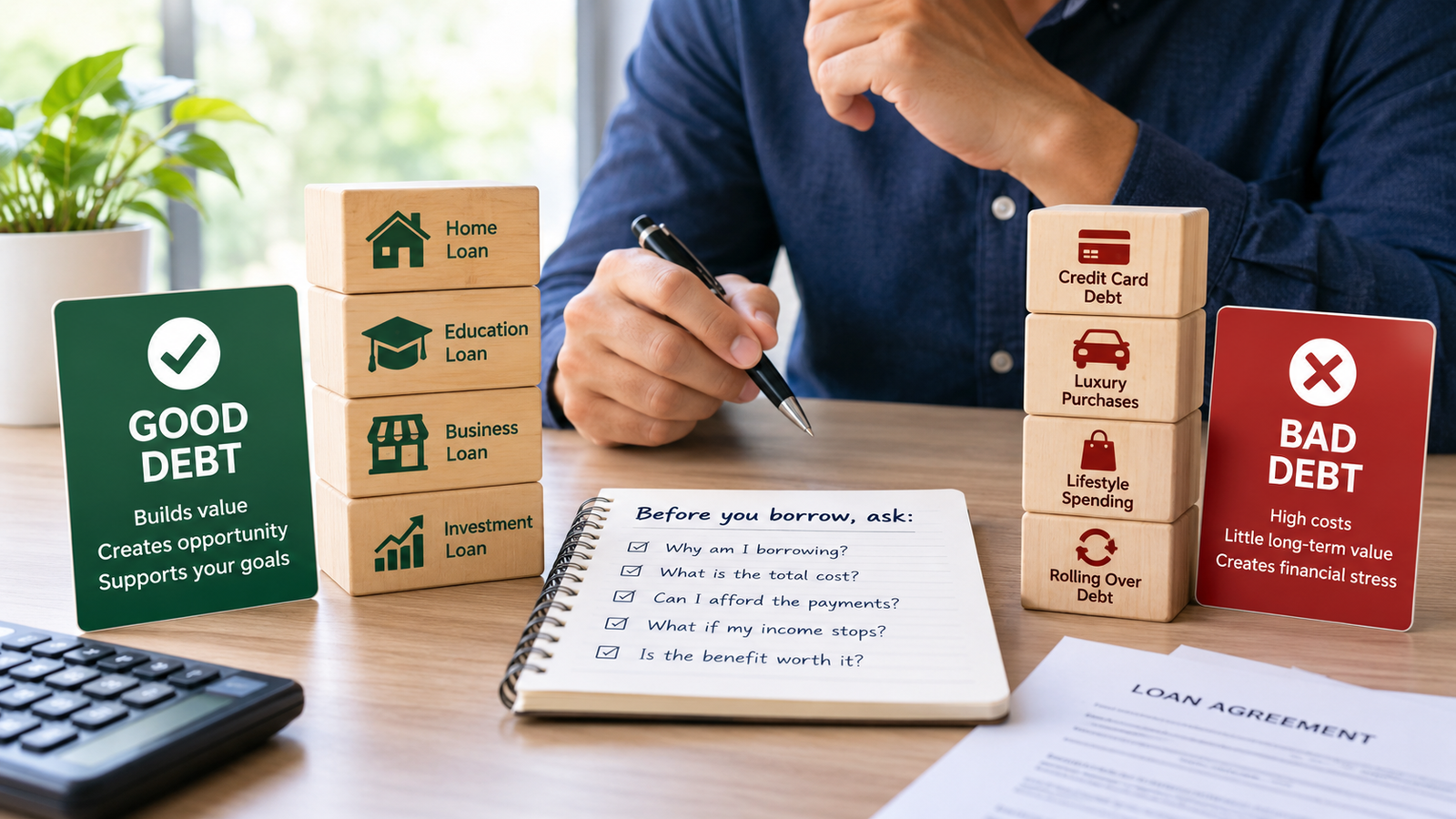
Good debt vs bad debt is an important distinction to understand before taking on any borrowing. Not all debt affects your finances in the same way. The cost of borrowing, the purpose of the loan, your ability to repay it and the value you receive in return can all determine whether debt supports your financial goals or creates additional financial pressure.
The important question is not simply “Is debt good or bad?” It is:
What is the debt being used for, how much does it cost, and can you comfortably repay it?
This guide explains the difference between productive and potentially harmful borrowing and provides a practical framework for evaluating debt before taking it on.
What Is Debt?
Debt is money borrowed from a bank, financial institution, company, family member or another lender that must normally be repaid over an agreed period.
The borrower may also have to pay interest, profit, fees or other charges depending on the type of financing.
Common forms of borrowing include:
- Home financing
- Personal loans
- Vehicle financing
- Credit cards
- Education loans
- Business financing
- Consumer financing
- Overdrafts and other short-term facilities
Not all debt has the same financial impact.
Before taking on debt, you can use our Loan / EMI Calculator to estimate the monthly payment, total interest and total repayment.
Good Debt vs Bad Debt: What’s the Difference?
Understanding good debt vs bad debt starts with looking at why you are borrowing, how much the borrowing costs, and whether the debt supports or weakens your overall financial position. A loan that helps fund an asset or productive activity may have a different financial impact from borrowing used mainly for short-term consumption.
What Is “Good Debt”?
The term good debt generally refers to borrowing that has a reasonable financial purpose and may help create or preserve long-term value.
However, “good” does not mean risk-free or automatically beneficial.
1. Borrowing for Education
Education financing can potentially increase a person’s future earning capacity.
For example, borrowing to obtain a professional qualification may make financial sense if:
- The cost is reasonable
- The qualification has genuine value
- Expected future income can support repayment
- The borrower understands the total financing cost
The same borrowing can become problematic if the cost is excessive or repayment depends on unrealistic future income.
2. Home Financing
A home is both a financial commitment and a personal need.
Appropriate home financing can allow a household to acquire a property without waiting many years to accumulate the full purchase price.
But affordability is critical. A property should not be considered affordable simply because a lender is willing to provide financing.
Consider:
- Monthly instalments
- Total financing cost
- Down payment
- Maintenance and other ownership costs
- Income stability
- Future financial commitments
3. Business Financing
Borrowing can help a business purchase equipment, expand operations, increase inventory or finance working capital.
Business borrowing can be productive when the expected business cash flows are sufficient to support the financing.
However, borrowing simply to cover continuing losses can create a larger problem rather than solve one.
4. Financing Productive Assets
Some borrowing is used to acquire assets that generate income or provide a clear long-term economic benefit.
Examples may include:
- Business equipment
- Income-generating assets
- Property used for business
- Technology required for business operations
The key consideration is whether the economic benefit reasonably justifies the cost and risk of borrowing.
What Is “Bad Debt”?
The term bad debt is commonly used for borrowing that provides little lasting financial benefit while creating a significant repayment burden.
Again, the label depends on circumstances.
1. High-Cost Consumer Debt
Borrowing at a high effective cost to purchase something that quickly loses value can put pressure on household finances.
The problem becomes greater when minimum payments are made repeatedly while the balance continues to accumulate.
2. Borrowing for Lifestyle Spending
Using debt to regularly finance holidays, expensive gadgets, entertainment or other discretionary spending can become dangerous when there is no realistic repayment plan.
A one-off purchase is different from relying on borrowing to maintain a lifestyle that income cannot support.
3. Repeated Credit Card Balances
Credit cards can be useful payment tools when balances are paid promptly.
The problem arises when a person continually carries expensive revolving debt and pays only the minimum amount required.
Small monthly payments can make a large balance appear manageable while the financing cost continues to accumulate.
4. Borrowing to Repay Existing Borrowing
Taking new debt to make payments on old debt can sometimes be part of a legitimate refinancing or restructuring strategy.
But repeatedly borrowing to meet existing repayments may indicate that the underlying cash-flow problem has not been solved.
5. Debt for Depreciating Assets
Borrowing to purchase an asset that loses value quickly deserves particular attention.
For example, a vehicle may be useful, but it normally depreciates over time. The borrower therefore needs to consider both the financing cost and the decline in the asset’s value.
When considering good debt vs bad debt, it is useful to look beyond the label and examine the full cost of borrowing. The interest rate, fees, repayment period, affordability and purpose of the loan all matter when assessing a borrowing decision.
For practical guidance on managing debt, interest costs and repayment, see the Consumer Financial Protection Bureau’s debt resources.
The Same Debt Can Be Good or Bad
One of the most important points about debt is that the same type of loan can produce very different outcomes for different people.
Consider vehicle financing.
For someone who needs a vehicle to operate a business and generate income, the financing may support productive activity.
For someone who already has several loans and is borrowing for an expensive vehicle primarily for lifestyle reasons, the same type of financing may create unnecessary pressure.
Therefore, don’t judge debt only by its name.
Look at:
Purpose + Cost + Affordability + Risk + Expected Benefit
Five Questions to Ask Before Borrowing
Before accepting financing, ask yourself these questions.
1. Why am I borrowing?
Be specific.
Is the money being used for:
- A genuine need?
- An investment in education?
- A business opportunity?
- A home?
- An asset?
- An emergency?
- Lifestyle spending?
If you cannot clearly explain why you need the money, borrowing deserves additional scrutiny.
2. What Is the Total Cost?
Do not look only at the monthly instalment.
Consider:
- Principal borrowed
- Interest or profit
- Processing fees
- Insurance or takaful where applicable
- Documentation charges
- Early settlement charges, if any
- Other associated costs
A loan with a low monthly payment can still be expensive if the repayment period is very long.
3. Can I Afford the Payment?
Calculate the expected monthly payment and compare it with your reliable income.
Then consider what happens if:
- Your income falls
- You lose your job
- Household expenses increase
- Interest or other financing costs change
- An unexpected expense occurs
A debt that is affordable only when everything goes according to plan may be too risky.
4. What Happens If My Income Stops?
This is where an emergency fund becomes important.
Before taking significant long-term debt, consider whether you have sufficient cash reserves to deal with temporary loss of income or unexpected expenses.
You can read our guide on how much to keep in an emergency fund for more information.
5. What Am I Giving Up?
Debt repayments reduce the money available for other priorities.
A large monthly instalment may mean less money available for:
- Saving
- Investing
- Retirement
- Education
- Family needs
- Emergency reserves
The cost of debt therefore includes not only the financing charges but also the financial flexibility you give up.
A Simple Debt Test
Before borrowing, try this five-part test:
Purpose: Is the borrowing necessary or financially productive?
Cost: What will I pay in total?
Affordability: Can my normal income comfortably support the repayments?
Resilience: Could I continue paying if my circumstances changed?
Benefit: Is the expected benefit reasonably worth the financial commitment?
If several answers are unclear, slow down before taking the debt.
Good Debt Does Not Mean Unlimited Debt
Even productive borrowing can become excessive.
A business can borrow too much.
A household can take on too large a mortgage.
An educated professional can still accumulate excessive personal loans.
The important issue is the relationship between debt and cash flow.
Borrowing becomes increasingly risky when repayments consume a large portion of reliable income and leave little room for saving or unexpected expenses.
Debt and Your Financial Goals
Debt decisions should be considered alongside your wider financial plan.
For example, someone may have a choice between:
- Paying down existing debt
- Building an emergency fund
- Investing additional money
- Making a major purchase
There is no universal answer that applies to everyone.
The appropriate decision depends on the financing cost, liquidity needs, risk tolerance, income stability and financial goals.
How to Manage Existing Debt
If you already have several debts, start by creating a complete list.
Record:
| Debt | Outstanding Balance | Monthly Payment | Cost | Remaining Term |
|---|---|---|---|---|
| Loan A | — | — | — | — |
| Credit Card | — | — | — | — |
| Vehicle Financing | — | — | — | — |
Then identify which debts are the most expensive and which payments are placing the greatest pressure on your monthly cash flow.
Avoid taking new borrowing simply because an existing payment feels difficult.
First understand the underlying cash-flow problem.
Debt Consolidation: A Word of Caution
Debt consolidation can sometimes simplify repayments or reduce financing costs.
But a lower monthly payment does not automatically mean a cheaper loan.
For example, extending the repayment period may reduce the monthly instalment while increasing the total amount paid over the life of the financing.
Always compare the total cost, not just the monthly payment.
Conventional and Islamic Financing
In Pakistan, consumers may encounter both conventional lending and Islamic financing structures.
The terminology and contractual structure can differ, but the same practical questions remain important:
- What is the total financial obligation?
- What are the applicable charges or profit?
- What is the repayment schedule?
- What happens if a payment is late?
- What are the early settlement terms?
- What security or collateral is required?
Read the actual financing documents and understand the obligations before signing.
Final Thoughts
Debt is a financial tool.
Used carefully, it can help finance education, housing, business activity or other important goals. Used without proper planning, it can reduce financial flexibility and create long-term stress.
Instead of asking simply “Is this good debt or bad debt?”, ask:
Why am I borrowing?
How much will it really cost?
Can I comfortably repay it?
What happens if my circumstances change?
Is the benefit worth the financial commitment?
Those questions provide a much more useful framework for making borrowing decisions.
This article is for general educational purposes and does not constitute personal financial advice.
2 thoughts on “Good Debt vs Bad Debt: Understanding Borrowing”
Comments are closed.