
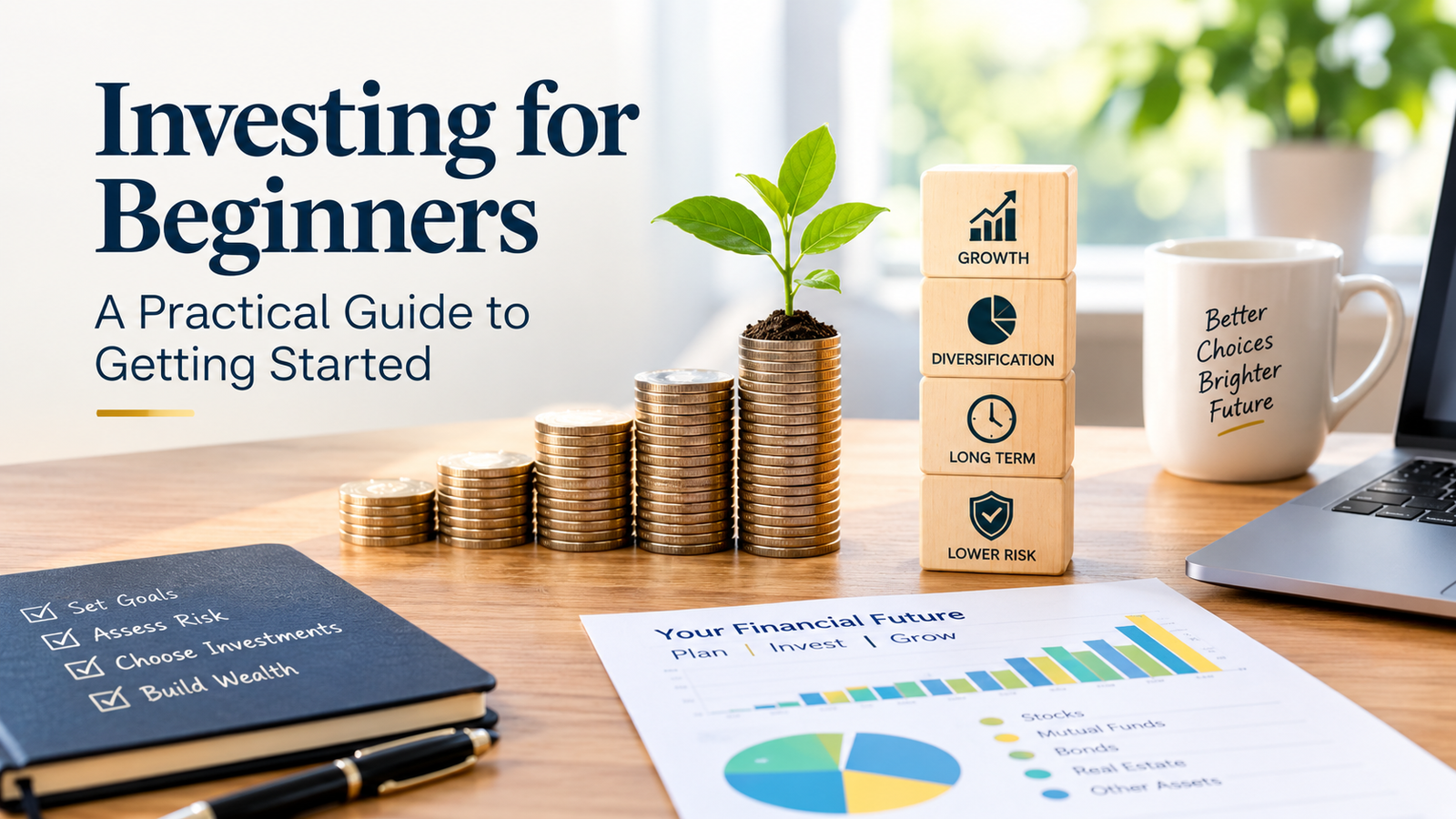
Investing for beginners can feel confusing, especially with so many investment options and different levels of risk.
There are stocks, mutual funds, bonds, government securities, property and many other investment options. Each has different levels of risk, potential returns, liquidity and complexity.
The good news is that you do not need to understand every investment product before you begin.
A better starting point is to understand the basic principles of investing, identify your financial goals and choose investments that match your time horizon and ability to accept risk.
This guide explains the fundamentals of investing and provides a practical framework for beginners.
What Is Investing?
Investing means putting money into an asset or financial product with the expectation that it may generate income, increase in value, or both over time.
Examples include:
- Shares of companies
- Mutual funds
- Government securities
- Bonds and other fixed-income investments
- Property
- Business investments
The return from an investment may come from income, such as dividends or profit distributions, capital appreciation, or a combination of both.
Unlike simply keeping money in a bank account or holding cash, investing generally involves some level of uncertainty.
The value of an investment can rise or fall.
Saving vs Investing
Saving and investing serve different purposes.
Saving generally means keeping money in relatively accessible and lower-risk forms for short-term needs and financial reserves.
Investing generally involves accepting some level of risk in pursuit of longer-term growth or income.
For example:
- Money needed for an emergency should generally remain accessible.
- Money needed for a major purchase in the near future may not be suitable for a highly volatile investment.
- Money intended for a long-term financial goal may have more time to absorb market fluctuations.
The two are not competing concepts. A sound financial plan can include both saving and investing.
Investing for Beginners: Key Principles to Understand
There are several reasons people invest.
1. Building Long-Term Wealth
Investing can allow your money to participate in the growth of businesses, economies and financial markets.
2. Protecting Purchasing Power
Inflation reduces the purchasing power of money over time.
If your money earns less than the rate at which prices increase, its real purchasing power may decline.
3. Generating Income
Some investments can provide income through:
- Dividends
- Profit distributions
- Interest or other returns, depending on the investment structure
- Rental income from property
4. Reaching Financial Goals
Investing can be part of planning for:
- Retirement
- Education
- Buying a home
- Long-term family needs
- Financial independence
The appropriate investment depends heavily on when the money will be needed. For investing for beginners, starting with simple and familiar investment options can make the learning process easier.
Understand Risk and Return
One of the most important concepts for a new investor is the relationship between risk and potential return.
Generally, investments offering higher potential returns also involve greater uncertainty or risk.
This does not mean that every risky investment will produce a high return.
It means that investors normally need to accept greater uncertainty when seeking higher potential returns.
For example, the price of an individual stock can change significantly over a short period. A lower-volatility investment may have more limited growth potential.
The key question is not:
“Which investment gives the highest return?”
A better question is:
“What level of risk is appropriate for my goal and circumstances?”
Your Time Horizon Matters
Your time horizon is the period before you expect to need the money.
It can have a major influence on investment decisions.
Short-Term Goals
If you need the money soon, protecting capital and maintaining access to funds may be more important than pursuing high growth.
Medium-Term Goals
With a medium-term horizon, you may have more flexibility, but you still need to consider the possibility of market declines before the money is required.
Long-Term Goals
Long-term goals provide more time for investments to experience periods of growth and decline.
This does not eliminate risk, but time can be an important factor when dealing with market volatility.
Common Types of Investments
Beginners should understand the basic characteristics of the main investment categories.
Stocks
Stocks represent ownership in companies.
Investors may potentially benefit from:
- Capital appreciation
- Dividends
However, individual stocks can be volatile, and investors can lose money.
Mutual Funds
A mutual fund pools money from multiple investors and invests according to a defined strategy.
Depending on the fund, investments may include equities, fixed-income instruments, money-market instruments or other assets.
Mutual funds can provide diversification and professional management, but they still carry investment risk.
Government Securities and Fixed Income
Government securities and other fixed-income investments generally provide defined or structured returns according to their terms.
They can play an important role in portfolios, particularly where income, capital preservation or lower volatility is an important consideration.
However, fixed income does not mean that every investment is completely risk-free.
Property
Property can generate rental income and may appreciate over time.
However, property normally requires significant capital and can involve:
- Maintenance costs
- Taxes and fees
- Low liquidity
- Market risk
- Concentration risk
Business Investments
Investing in a business can potentially generate substantial returns, but the risks can also be significant.
Business investments require an understanding of the business model, financial performance, management and market conditions.
Diversification: Don’t Put Everything in One Place
Diversification means spreading investments across different assets, companies, sectors or investment types.
The objective is to avoid having your entire financial position depend on one investment.
For example, an investor whose entire portfolio consists of shares in one company faces much greater company-specific risk than someone holding a diversified portfolio.
Diversification does not eliminate losses or guarantee returns. Diversification can help reduce the impact of a poor-performing investment on your overall portfolio. The SEC’s Investor.gov provides a useful explanation of diversification and asset allocation
It is simply a way of managing concentration risk.
Start With Your Financial Foundation
Investing should not normally be the first financial priority if your basic financial foundation is not in place.
Before taking significant investment risk, consider whether you have:
- A reasonable emergency fund
- Control over high-cost debt
- Adequate insurance or protection where appropriate
- Clear financial goals
- A manageable monthly budget
Your emergency savings should serve a different purpose from your long-term investments.
If you are interested in emergency funds, see our guide:
How Much Should You Keep in an Emergency Fund?
How Much Should You Invest?
There is no single percentage that is appropriate for everyone.
The amount you can invest depends on:
- Income
- Expenses
- Existing savings
- Debt
- Family responsibilities
- Financial goals
- Emergency reserves
- Investment horizon
A practical approach is to determine how much surplus cash you can invest consistently without compromising essential expenses or your emergency reserves.
Consistency can matter more than trying to invest a large amount once and then stopping.
Investing a Lump Sum vs Investing Regularly
Investors may invest a large amount at once or invest smaller amounts periodically.
Lump-Sum Investing
A lump-sum investment puts the available money into the market at one time.
The advantage is that the entire amount is exposed to potential investment returns immediately.
The disadvantage is that the investment may experience a decline shortly after you invest.
Regular Investing
Regular investing involves investing a fixed amount at predetermined intervals.
This can help create discipline and reduce the pressure of trying to identify the perfect time to invest.
However, regular investing does not guarantee better returns.
The appropriate approach depends on the investor’s circumstances, available funds and investment strategy.
Understand Compounding
Compounding occurs when returns generated by an investment are themselves allowed to generate additional returns over time.
For example, if an investment earns a return and that return remains invested, future returns can be earned on both the original amount and previously accumulated returns.
This is one reason why time can be an important advantage for long-term investors.
However, actual investment returns are not guaranteed, and real-world returns can vary considerably from year to year.
Avoid Chasing Past Performance
An investment that performed exceptionally well in the past may not produce the same result in the future.
Before investing, consider:
- What generated the historical return?
- What risks were involved?
- Is the performance sustainable?
- What are the costs?
- What could cause the investment to decline?
- Does it fit your own financial objective?
Past performance is useful information, but it should not be treated as a guarantee of future results.
Watch Investment Costs
Costs can have a meaningful effect on long-term investment results.
Depending on the investment, costs may include:
- Management fees
- Brokerage charges
- Transaction costs
- Fund expenses
- Taxes
- Account charges
- Other applicable fees
Two investments with similar gross returns can produce different net results after costs.
Always understand what you are paying. One of the most important principles of investing for beginners is to avoid making decisions based on short-term market movements.
Common Investing Mistakes
Beginners often make avoidable mistakes.
Investing Without a Goal
Buying an investment without knowing why you are investing can lead to poor decisions when markets change.
Chasing Quick Profits
Trying to make money quickly can encourage excessive risk-taking.
Putting Everything Into One Investment
Concentration can significantly increase risk.
Investing Money You Need Soon
An investment can fall in value at exactly the time you need the money.
Following Tips Without Research
A recommendation from a friend, social media account or online forum is not a substitute for understanding the investment.
Ignoring Risk
Potential return should always be considered alongside the possibility of loss.
Constantly Buying and Selling
Frequent trading can increase costs and may cause investors to react emotionally to short-term market movements.
A Simple Framework for Beginners
Before making an investment, work through these seven questions:
1. What is my financial goal?
Be specific about what you are trying to achieve.
2. When will I need the money?
Your time horizon matters.
3. How much can I invest?
Consider your income, expenses and existing financial commitments.
4. How much risk can I accept?
Think about both your financial capacity and your ability to remain comfortable when the investment declines.
5. What am I investing in?
Understand the asset, how it generates returns and what could cause its value to fall.
6. What will it cost me?
Consider all relevant fees, charges and taxes.
7. Does it fit my overall portfolio?
Consider diversification rather than evaluating every investment in isolation.
Investing in Pakistan
Investors in Pakistan have access to a range of investment options, including:
- Pakistan Stock Exchange-listed shares
- Mutual funds
- Government securities
- Islamic investment products
- Bank and other financial institution products
- Property
- Business investments
Each has different characteristics and risks.
Future Equicio guides will explore these areas in greater detail, including mutual funds in Pakistan, PSX investing, fixed income and Islamic investing.
Final Thoughts
Investing does not have to begin with complicated strategies.
A strong starting point is to understand your goal, establish an appropriate time horizon, assess your risk, diversify sensibly and invest consistently.
The objective is not to find the investment that performed best yesterday.
It is to build an investment approach that is understandable, sustainable and appropriate for the financial goal you are trying to achieve.
The goal of investing for beginners is not to find a perfect investment, but to develop a disciplined approach that can be followed over time.
Understand the investment before you invest.
Related Financial Tools
If you are getting started with investing, these practical tools can help you apply some of the concepts discussed in this guide and make more informed financial decisions.
- Compound Interest Calculator
- Investment Return Calculator
- Financial Tools and Calculators
- Good Debt vs Bad Debt
This article is for general educational purposes and does not constitute personal investment advice.
4 thoughts on “Investing for Beginners: A Practical Guide to Getting Started”
Comments are closed.