
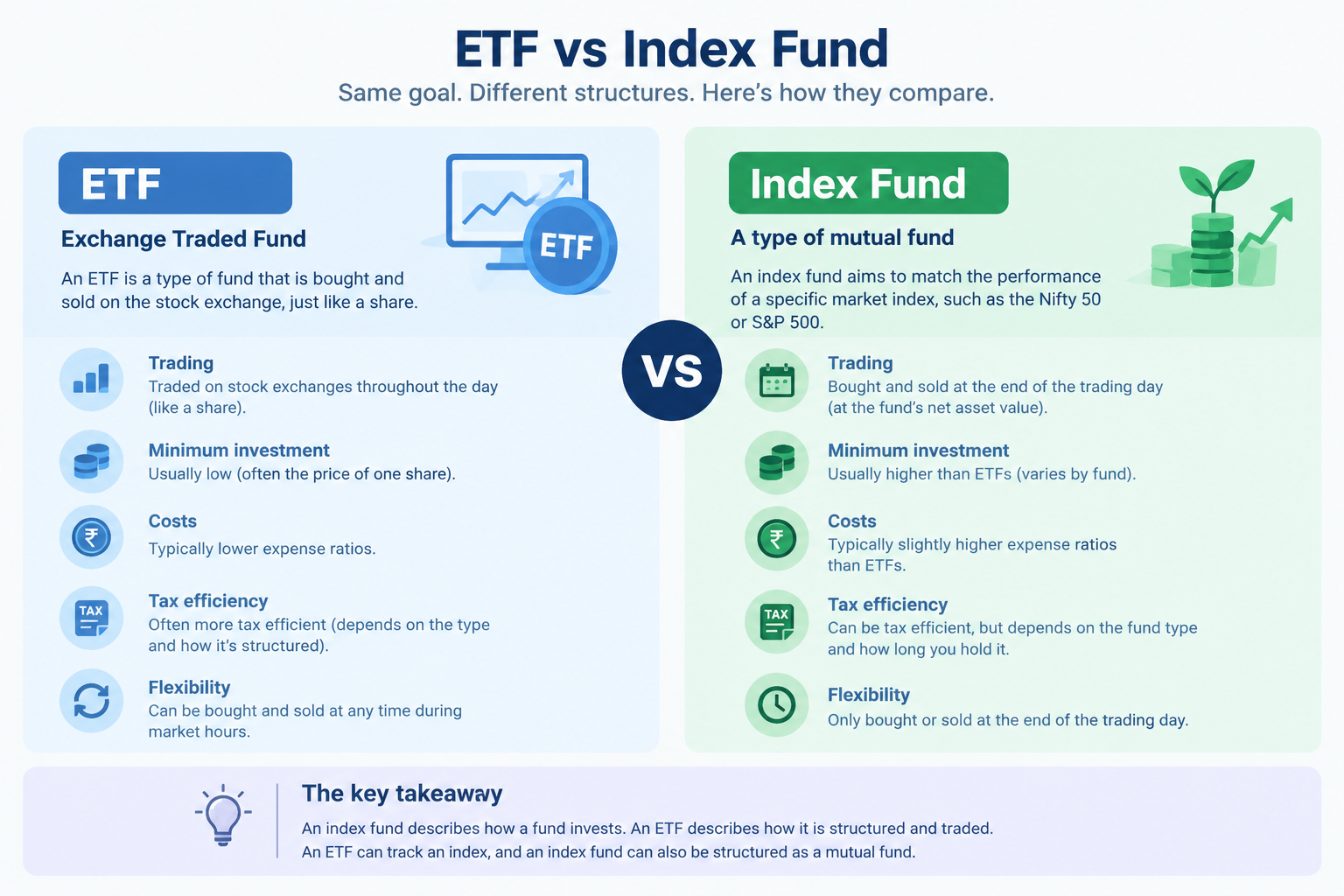
ETF vs Index Fund is a common comparison for investors choosing a low-cost way to build long-term wealth. Although both can provide diversified investment exposure, they differ in structure, trading, costs, and tax treatment. Understanding these differences can help you choose an investment that fits your goals.
Index funds and exchange-traded funds (ETFs) are popular investment options for people who want exposure to a range of stocks, bonds or other assets without selecting every investment individually.
However, comparing ETF vs Index Fund can be confusing because the terms describe different things. An index fund follows a market index, while an ETF is an investment fund structure that trades on an exchange. An ETF can itself be an index fund.
Understanding this distinction can help you compare investment products, evaluate fees and select an approach that suits your financial goals.
This guide explains how index funds and ETFs work, compares their costs and trading features, and highlights the factors to consider before investing.
What Is an Index Fund?
An index fund is an investment fund designed to track the performance of a particular market index.
An index measures the performance of a group of securities according to defined rules. For example, an index might track large companies in one country, a broad global equity market, government bonds or a specific investment sector.
An index fund attempts to replicate the index’s performance by holding all or a representative sample of the securities included in it, or by using other permitted methods to track the benchmark.
Index funds generally follow a passive investment strategy. Instead of attempting to select investments that outperform a benchmark through frequent active decisions, the fund seeks to follow the index as closely as practical.
Index funds can be structured as traditional mutual funds or ETFs. Therefore, the term index fund does not, by itself, tell you how the investment is bought and sold.
What Is an Exchange-Traded Fund (ETF)?
An exchange-traded fund is an investment fund whose shares or units trade on a stock exchange during market hours.
An ETF may hold stocks, bonds or other assets, depending on its investment objective and legal structure. Investors purchase ETF shares through a brokerage account, and the shares trade at market prices throughout the trading session.
Many ETFs track market indexes, but not all do. Some ETFs follow actively managed strategies or target particular sectors, asset classes or investment objectives.
The price of an ETF share can differ slightly from the net asset value (NAV) per share, which represents the value of the fund’s assets minus liabilities on a per-share basis.
ETFs offer exchange trading, but investors should understand brokerage costs, bid-ask spreads, market-price premiums or discounts, and the risks associated with the underlying holdings.
ETF vs Index Funds: Key Differences
The main difference in the ETF vs Index Fund comparison is that an ETF describes how a fund is structured and traded, while an index fund describes its investment strategy. An ETF can track a market index, and an index fund can be structured as either an exchange-traded fund or a mutual fund.
| Feature | Index mutual fund | ETF |
|---|---|---|
| What defines it? | A fund that tracks an index | A fund structure that trades on an exchange |
| Trading method | Usually bought or redeemed through the fund at a price based on the next calculated NAV | Bought and sold on an exchange at market prices |
| Pricing | Generally calculated once each business day for traditional open-end mutual funds | Market prices fluctuate during trading hours |
| Minimum investment | Depends on the fund and provider | Depends on the share price, broker and availability of fractional shares |
| Transaction costs | May include sales charges or other account-specific fees | May include commissions, bid-ask spreads and other trading costs |
| Automation | Often supports automatic contributions, subject to provider rules | Depends on the broker and available recurring-investment features |
| Index tracking | Possible | Possible, but not required |
| Investment risk | Depends on the underlying holdings and fund structure | Depends on the underlying holdings and fund structure |
This table compares index mutual funds with ETFs. It is not a comparison of all index funds with all ETFs because an index-tracking ETF is also an index fund.
Index Funds vs ETFs: Which Is Cheaper?
Neither structure is automatically cheaper in every situation. You should compare the total cost of owning each investment rather than focusing on a single fee.
1. Expense ratio
The expense ratio represents the fund’s annual operating expenses as a proportion of its assets.
These costs are generally deducted from fund assets and therefore reduce the returns investors receive.
For example, suppose two otherwise comparable funds each earn a hypothetical 7% gross return before expenses.
- Fund A has annual expenses of 0.10%.
- Fund B has annual expenses of 0.50%.
The difference in annual expenses is 0.40 percentage points. Over long periods, differences in costs can have a meaningful effect on investment outcomes because they also affect subsequent compounding.
These figures are illustrative, not actual fund quotes. Always check the current fee information for the products you are considering.
2. Brokerage and transaction costs
ETF investors may pay brokerage commissions, bid-ask spreads or other transaction-related costs when buying and selling shares.
Traditional index mutual funds may have different fee arrangements, including possible sales charges, account fees or minimum investment requirements.
If you invest small amounts frequently, a fixed transaction charge can represent a significant proportion of each contribution.
3. Premiums and discounts to NAV
An ETF’s market price may be higher or lower than its underlying NAV.
Buying at a premium or selling at a discount can affect the price you receive, particularly in funds with limited liquidity or holdings that are difficult to value or trade.
4. Other costs
Foreign exchange charges, account administration fees and applicable taxes may also influence your overall result.
The appropriate comparison includes the costs relevant to your investment amount, trading frequency, account and country.
When comparing ETF vs Index Fund costs, look beyond the expense ratio. Consider brokerage commissions, bid-ask spreads, account fees, and any minimum investment requirements. The lowest-cost option depends on the specific funds and your investment platform.
For additional guidance, consult Investor.gov’s explanation of mutual fund and ETF fees and expenses.
Which Is Better for Regular Monthly Investing?
Both index mutual funds and ETFs can support regular investing, but the practical experience depends on the provider and brokerage platform.
Index mutual funds
Traditional index mutual funds may be convenient for investors who want to contribute a fixed amount regularly. Some providers allow automatic investments, subject to their rules and minimum contribution requirements.
Purchases and redemptions are generally processed at the next applicable NAV calculation rather than at an intraday market price.
ETFs
ETFs may suit investors who prefer exchange trading and want to buy or sell during market hours.
Some brokers support recurring ETF purchases or fractional shares, while others require whole shares or charge transaction fees. Features vary by provider and jurisdiction.
What should you choose?
If your priority is simple, automated monthly investing, compare the recurring-investment facilities, minimum contributions and total costs available through your provider.
If you value exchange trading and intraday pricing, an ETF may be more convenient.
Neither option is inherently superior for every investor. The fund’s holdings, costs, risks and suitability are more important than the label alone.
The answer to ETF vs Index Fund depends on how you prefer to invest. ETFs offer intraday trading, while traditional index mutual funds generally transact at the next calculated net asset value. Both can be suitable for long-term investors when their costs, diversification, and investment objectives are appropriate.
You can also explore the principles of regular investing in Equicio’s guide to dollar-cost averaging.
Index Funds vs ETFs: Are They Equally Diversified?
Diversification depends on the underlying investments, not simply on whether a fund is an index mutual fund or an ETF.
A fund tracking a broad global equity index may hold securities across many companies and markets. A fund tracking a single industry or a small group of companies may be considerably more concentrated.
Two funds that track different indexes can also hold many of the same companies. Owning both does not necessarily provide as much additional diversification as their names suggest.
Before investing, review:
- The index or benchmark the fund tracks.
- The number and types of holdings.
- Concentration in individual companies or sectors.
- Geographic and currency exposure.
- The fund’s investment methodology.
- Whether the fund uses derivatives, sampling or leverage.
Diversification can spread exposure across investments, but it does not eliminate market risk or guarantee that a portfolio will avoid losses.
Do Index Funds and ETFs Offer the Same Returns?
If an index mutual fund and an ETF track the same benchmark, their pre-cost performance may be similar, but it will not necessarily be identical.
Differences can arise from:
- Expense ratios and other fund expenses.
- Transaction costs within the fund.
- Tracking methods and sampling.
- The timing of cash flows and distributions.
- Taxes and the fund’s legal structure.
- ETF market prices trading above or below NAV.
An index fund aims to track its benchmark, not guarantee the benchmark’s return. The index itself may also fall in value.
When comparing performance, use the same time period and check whether reported returns include reinvested distributions and account for fees. Historical performance is not a reliable guarantee of future results.
How to Choose Between an Index Fund and an ETF
Use the following checklist when comparing specific investments.
1. Identify your investment objective
Determine whether you are investing for retirement, a long-term savings goal, income or another purpose.
Your time horizon and tolerance for losses should influence the types of assets you choose.
2. Compare the underlying holdings
Do not select a fund based only on its name or recent returns. Review the benchmark, holdings, sector exposures and concentration risks.
3. Compare total costs
Check the expense ratio, brokerage charges, spreads, account fees and any relevant currency-conversion costs.
4. Check minimum investment requirements
Confirm whether the provider allows small contributions, fractional shares or automatic investments. These features may influence how easily you can maintain a regular investing plan.
5. Understand the trading and pricing process
Traditional mutual funds generally transact at a calculated NAV, while ETFs trade on an exchange throughout market hours. Decide which process better fits your needs.
6. Consider your tax circumstances
Tax treatment can differ by country, fund domicile, account type and investment income. Do not assume that a fund’s structure will produce the same tax outcome for every investor.
7. Review the fund documentation
Read the prospectus or equivalent product disclosure document, fee information and risk disclosures before investing.
For a practical introduction to diversified investing, see Investor.gov’s index fund guide.
Common Mistakes to Avoid
Assuming every ETF is an index fund: Some ETFs are actively managed or follow specialised strategies.
Assuming every index fund is an ETF: Traditional mutual funds can also track indexes.
Choosing solely by expense ratio: Brokerage charges, spreads, account fees and taxes can affect the total cost.
Ignoring diversification: A low-cost fund can still be concentrated in a narrow sector or a limited number of companies.
Comparing different benchmarks: Two funds may perform differently because they invest in different markets or securities.
Treating past returns as a promise: Neither an index fund nor an ETF guarantees a profit.
Overlooking currency exposure: An investment denominated in a foreign currency can expose you to exchange-rate movements, even when the underlying assets perform well.
Frequently Asked Questions
Are index funds and ETFs the same thing?
No. An index fund describes an investment strategy designed to track an index. An ETF describes a fund structure that trades on an exchange. An ETF can be an index fund, but not every ETF tracks an index.
Are ETFs better than index mutual funds?
Not universally. ETFs offer intraday exchange trading, while traditional index mutual funds may provide convenient automatic investing and NAV-based transactions. Costs, investment choices and provider features should guide your comparison.
Are index funds safer than ETFs?
Neither is inherently safer. Risk depends primarily on the underlying holdings, investment strategy, concentration, leverage and other characteristics of the product.
Can I invest in an ETF every month?
Often, yes. Some brokerage platforms support recurring ETF purchases and fractional shares, but availability and costs vary. Check the features and fees offered by your provider.
Do index funds guarantee market returns?
No. Index funds aim to track a benchmark but can underperform it because of fees, transaction costs and tracking differences. The underlying index can also lose value.
Should a beginner choose an index fund or an ETF?
A beginner should compare accessible investment options based on diversification, fees, simplicity, risk and the ability to contribute consistently. A low-cost, broadly diversified fund may be worth investigating, but suitability depends on individual circumstances and the available products.
Final Verdict: Index Funds vs ETFs
The choice between index funds and ETFs is not simply a choice between two competing investment strategies. Index funds describe how a portfolio seeks to track a benchmark, while ETFs describe how fund shares trade.
A traditional index mutual fund may suit investors who prefer straightforward contributions and NAV-based transactions. An index-tracking ETF may suit investors who value exchange trading and the flexibility it offers.
Compare the actual products, including their holdings, total costs, tracking differences and tax implications. The most suitable option is the one that fits your financial goals and allows you to invest in a way you understand and can maintain.
Ultimately, ETF vs Index Fund is not simply a choice between two competing investment strategies. An index fund follows an index-based investment approach, while an ETF is a fund structure that trades on an exchange. Compare the specific fund’s costs, holdings, and features before deciding.
Disclaimer: This article is for educational purposes only and does not constitute personalised investment, financial, tax or legal advice. Fund structures, costs, tax treatment and investor protections vary by jurisdiction and product. Investments can lose value.