
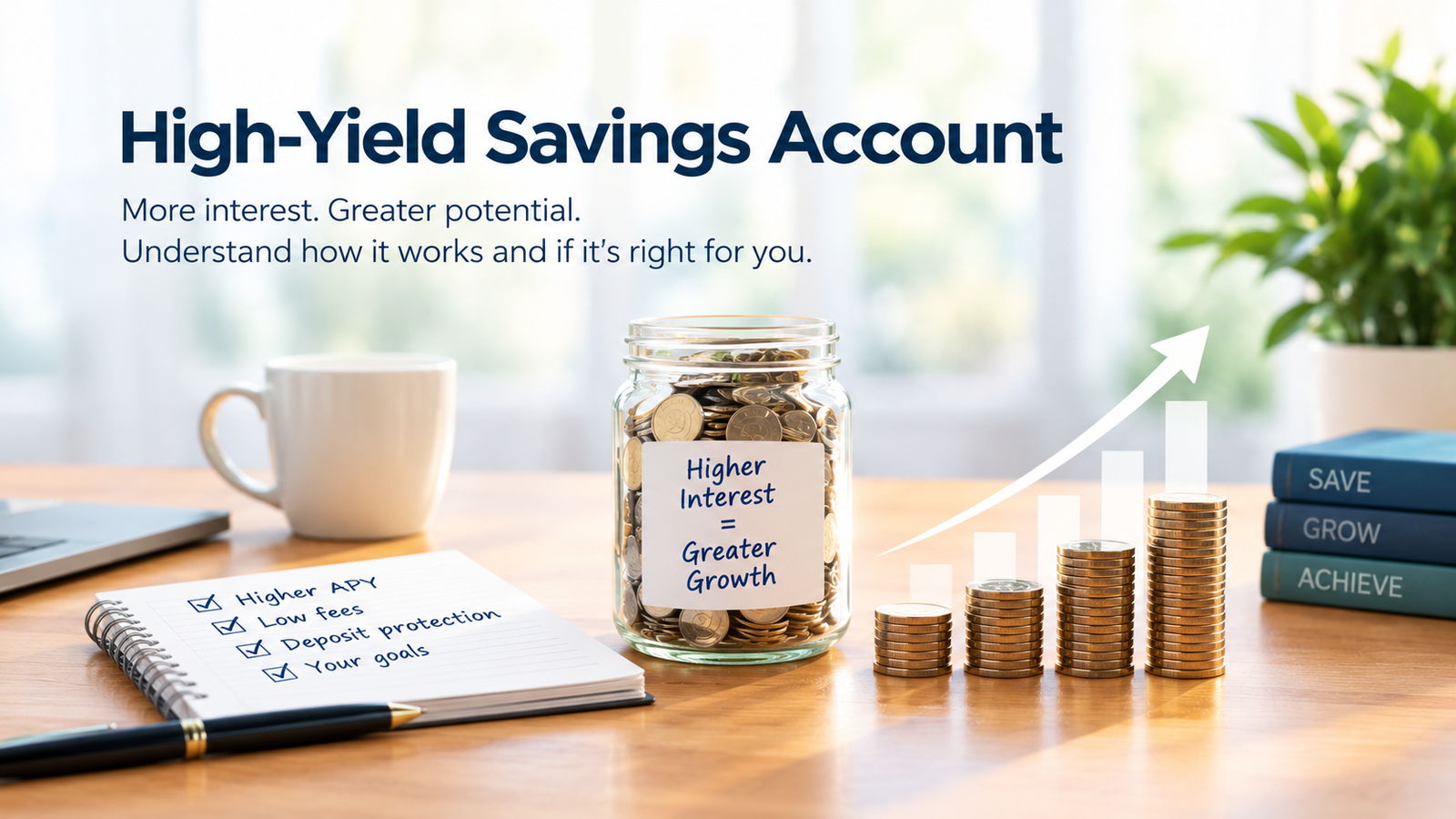
Saving money is an important part of financial planning, but where you keep your savings can affect how quickly they grow. A traditional savings account may offer convenience and easy access, while an account paying a more competitive interest rate can help your balance earn more over time.
A high-yield savings account is a savings account that offers a relatively high interest rate compared with other available savings accounts. These accounts are often marketed by online banks and financial institutions, although availability and account features vary by country.
A higher rate can be useful for emergency funds, short-term goals, and money that you want to keep accessible without exposing it to stock-market risk. However, the highest advertised rate is not necessarily the best choice once fees, withdrawal conditions, introductory offers, currency, and deposit protection are considered.
This guide explains how high-yield savings accounts work, how to compare them, and when they may fit into your financial plan.
What Is a High-Yield Savings Account?
A high-yield savings account is designed to pay interest on deposited money at a comparatively attractive rate.
The basic purpose is similar to that of a regular savings account: you deposit money, the institution pays interest according to the account terms, and you can access the balance subject to any applicable restrictions.
The main difference is the rate of interest. Even a seemingly small difference in rates can affect your earnings over time, particularly when you maintain a substantial balance.
The term high-yield savings account is especially common in the United States. Other countries may use different names for comparable products, including high-interest savings accounts, interest-bearing deposit accounts, or particular types of bank savings products.
Do not assume that products with similar names have identical terms. Interest calculation, access rules, tax treatment, and deposit protection depend on the institution and jurisdiction.
How Does a High-Yield Savings Account Work?
When you deposit money into a qualifying account, the institution pays interest according to its stated rate and account conditions.
The advertised rate may be expressed as an annual percentage yield (APY), an annual percentage rate, or another locally recognised measure. These measures are not always interchangeable.
APY generally reflects the effect of compounding over a year, whereas a nominal annual rate may not. When comparing accounts, check whether the quoted figures use the same convention.
The interest you earn depends on the account’s annual percentage yield (APY), balance, and applicable terms. To estimate how savings can grow over time, use the Investor.gov Compound Interest Calculator. You can also read the Consumer Financial Protection Bureau’s explanation of compound interest to understand how interest earned can contribute to future growth.
Example: Comparing two savings accounts
Suppose you have 10,000 currency units to deposit for one year.
| Account | Illustrative annual yield | Approximate interest over one year |
|---|---|---|
| Account A | 2% | 200 |
| Account B | 4% | 400 |
| Account C | 4.5% | 450 |
These figures assume the quoted rates apply for the entire year, the balance remains unchanged, and there are no fees or taxes. Actual interest may differ because of rate changes, compounding methods, balance requirements, and other account terms.
In this example, Account C earns 250 more than Account A over a year. The difference is meaningful, but it should be weighed against the account’s other conditions.
What Are the Benefits of a High-Yield Savings Account?
1. Potentially higher interest earnings
A competitive savings rate allows your cash to earn more than it might in an account paying a lower rate.
This can be particularly helpful for balances that you expect to hold for months or years, provided you continue to have suitable access to the money.
2. Access to money for unexpected expenses
Savings accounts are commonly used to hold emergency funds because they can provide access to money without requiring you to sell investments.
Before choosing an account for emergencies, verify how quickly withdrawals or transfers can be completed. An account with inconvenient access may not be suitable for money you might need urgently.
You can also use Equicio’s Emergency Fund guide to help estimate how much cash to keep available.
3. Lower exposure to market-price fluctuations
Unlike stocks or exchange-traded funds, a bank deposit does not normally fluctuate in market value in the same way. However, the safety of a deposit depends on the institution, the applicable protection scheme, and the account terms.
Deposit protection is subject to local eligibility rules and limits. It should not be confused with a guarantee against inflation or a promise that every financial product sold by a bank is protected.
4. A place for short-term savings
If you are saving for a planned expense, such as a holiday, tuition payment, vehicle purchase, or house deposit, an interest-bearing savings account may be appropriate when preserving the money and accessing it on time are priorities.
For money needed on a known date, compare the account’s withdrawal conditions with the timing of the expense.
5. A straightforward way to separate financial goals
You may choose to maintain separate savings accounts or labelled savings pots for different goals, where the provider supports them.
For example, keeping emergency savings separate from holiday savings can make it easier to track progress and avoid spending money intended for unexpected expenses.
What Are the Limitations and Risks?
A high-yield savings account is useful for some goals, but it is not a complete financial strategy.
Interest rates can change
Many savings accounts have variable rates. The provider may increase or reduce the rate in response to market conditions or its own pricing decisions, subject to applicable rules.
A high introductory rate may also expire after a specified period. Check whether the rate is promotional and what happens afterward.
Inflation can reduce purchasing power
Your balance may increase while its purchasing power falls.
For example, if your account earns 3% over a year but the prices of the goods and services you buy rise by 4%, your savings have earned a positive nominal return but a negative inflation-adjusted return before tax and fees.
The exact real return is calculated as:
Real return = (1 + nominal return) ÷ (1 + inflation rate) − 1
Equicio’s Investment Return Calculator can help you assess returns, while its guide to keeping money in cash discusses the role of cash in a financial plan.
Fees and account conditions can reduce the benefit
Some accounts require a minimum balance, restrict the number or type of withdrawals, or impose fees when specified conditions are not met.
Even a relatively small fee can offset the additional interest you expect to earn. Review the full fee schedule and account terms rather than comparing headline rates alone.
Deposit protection is not unlimited
Eligible deposits may be protected by a government-backed or other legally established deposit-protection scheme, depending on the country and institution.
Coverage limits, eligible institutions, account categories, and the treatment of different currencies can vary. Some investment products offered through banks are not deposits and may not receive the same protection.
Confirm the applicable rules with the official deposit-protection authority in your jurisdiction.
How to Choose the Right High-Yield Savings Account
The best account is not necessarily the one with the highest advertised rate. Consider the following factors before opening an account.
1. Compare the effective annual yield
Compare rates using the same measure and time period. If one provider advertises an APY and another advertises a nominal annual rate, establish how they differ before deciding which is better.
Also check whether the rate applies to your entire balance or only to a specified portion.
2. Check fees and minimum balances
Review monthly maintenance charges, minimum opening deposits, balance requirements, transfer fees, and any other costs.
Calculate the expected net benefit after fees. A slightly lower-rate account with no meaningful fees may be more attractive than an account with a higher headline rate and restrictive conditions.
3. Understand access and withdrawal rules
Consider how quickly you can transfer funds to your everyday account and whether withdrawals are limited or subject to notice.
For emergency savings, convenient access may be more important than a small increase in interest.
4. Confirm deposit protection
Check whether the institution is licensed or authorised to accept deposits and whether your account qualifies for the relevant protection scheme.
Do not assume that an institution is covered merely because it has a familiar brand or offers a product through a financial app. Where an account is provided through a third party, identify the actual deposit-taking institution and understand the arrangement.
5. Review the currency
A savings account denominated in your usual spending currency can help avoid exchange-rate uncertainty when you need to use the money.
A foreign-currency account may be useful for a specific future obligation in that currency, but exchange-rate movements can increase or reduce the value of your savings when converted back.
Compare currency conversion charges, interest rates, and the currency in which your future expenses will occur.
6. Check tax treatment
Interest may be taxable, subject to withholding, or treated differently according to local law and the account type.
Compare the amount you expect to retain after applicable taxes, not just the gross interest displayed by the provider. Tax rules can change, so consult current official guidance for your jurisdiction.
7. Check the institution’s reliability and service
Consider the provider’s regulatory status, customer support, account access, transaction security, and ability to resolve problems.
An account should be convenient and dependable, especially if it holds money reserved for essential expenses.
High-Yield Savings Accounts vs Other Places to Keep Money
Different financial products serve different purposes. Compare them based on the goal for which you are saving.
| Feature | High-yield savings account | Fixed-term deposit | Money market fund | Stocks or equity funds |
|---|---|---|---|---|
| Main purpose | Accessible savings | Saving for a defined term | Investing in short-term market instruments | Long-term growth |
| Access | Usually relatively flexible, subject to terms | May be restricted or penalised before maturity | Depends on fund and settlement terms | Usually tradable, but sale proceeds and prices vary |
| Return | Usually variable | Often fixed or specified for the term | Variable and not guaranteed | Variable and can be negative |
| Investment risk | Depends on institution and deposit protection | Depends on institution, terms, and protection | Investment risk; not normally a bank deposit | Market risk |
| Best suited to | Emergency and short-term savings | Money not needed before maturity | Investors seeking exposure to money-market instruments | Long-term goals with capacity to tolerate losses |
A money market fund is an investment product, not automatically a bank deposit. Its value, liquidity, and protections differ from those of a savings account. Similarly, stocks and equity funds can lose value and are generally unsuitable for money that must be available at a fixed date in the near future.
The appropriate choice depends on your time horizon, risk tolerance, access requirements, and local financial system.
How Much Money Should You Keep in a Savings Account?
There is no single amount that suits everyone. Your savings balance should reflect your essential expenses, income stability, dependants, insurance coverage, debt obligations, and the time until you will need the money.
A common starting point for an emergency fund is three to six months of essential living expenses. Some people may need more—for example, if their income is irregular, they support dependants, or they would find it difficult to replace their income quickly.
Consider separating your cash into three categories:
- Emergency reserves: Money for unexpected expenses and interruptions to income.
- Short-term goals: Funds intended for planned spending in the near future.
- Long-term investments: Money that can remain invested for longer periods and tolerate market fluctuations.
Avoid holding every available asset in cash simply because a savings account pays an attractive rate. At the same time, do not invest essential emergency money in volatile assets solely to pursue higher returns.
Your financial plan should balance liquidity, capital preservation, and long-term growth.
Frequently Asked Questions
Are high-yield savings accounts safe?
They may be suitable for cash savings, but safety depends on the institution, account terms, currency, and applicable deposit-protection rules. Confirm the provider’s regulatory status and the exact protection available before depositing money.
Can the interest rate change?
Yes. Many accounts offer variable rates, and promotional rates may expire. Review the account’s terms and compare rates periodically.
Do high-yield savings accounts beat inflation?
Not necessarily. The rate may be higher than that of a standard savings account but still lower than inflation. Taxes and fees can reduce the real return further.
Can I withdraw money whenever I want?
That depends on the account. Many savings accounts allow relatively easy withdrawals, but some have transfer restrictions, notice periods, transaction limits, or other conditions. Check these rules before using an account for emergency savings.
Are high-yield savings accounts available in every country?
The term is most commonly used in the United States. Similar products exist in many other markets, but their names, rates, eligibility rules, and protections vary. Compare locally available accounts and consult the relevant financial regulator or deposit-protection authority.
Should I use a savings account or invest my money?
The choice depends on when you need the money and how much risk you can tolerate. Savings accounts may suit emergency reserves and near-term goals. Diversified investments may be more appropriate for some long-term goals, but investment values can fall and returns are not guaranteed.
Final Thoughts
A high-yield savings account can be a practical part of a financial plan. It may help your cash earn a more competitive return while remaining accessible for emergencies and planned expenses.
Before choosing an account, compare the effective rate, fees, access rules, deposit protection, currency, and tax treatment. Then consider whether the account matches the purpose of the money you intend to hold there.
The objective is not simply to find the highest advertised rate. It is to keep the right amount of money in an account that offers a suitable balance of accessibility, protection, and return.
Disclaimer: This article is for general educational purposes only and does not constitute personalised financial, investment, tax, or legal advice. Account terms, interest rates, tax rules, and deposit-protection arrangements vary by jurisdiction and provider. Verify current details with the relevant institution and official authorities before making a financial decision.