
How to start investing is one of the most important questions for anyone who wants to build long-term wealth. Many beginners enter the stock market too quickly, buy investments without understanding their risks, and become discouraged when prices fall. A better approach is to develop your knowledge and confidence gradually.
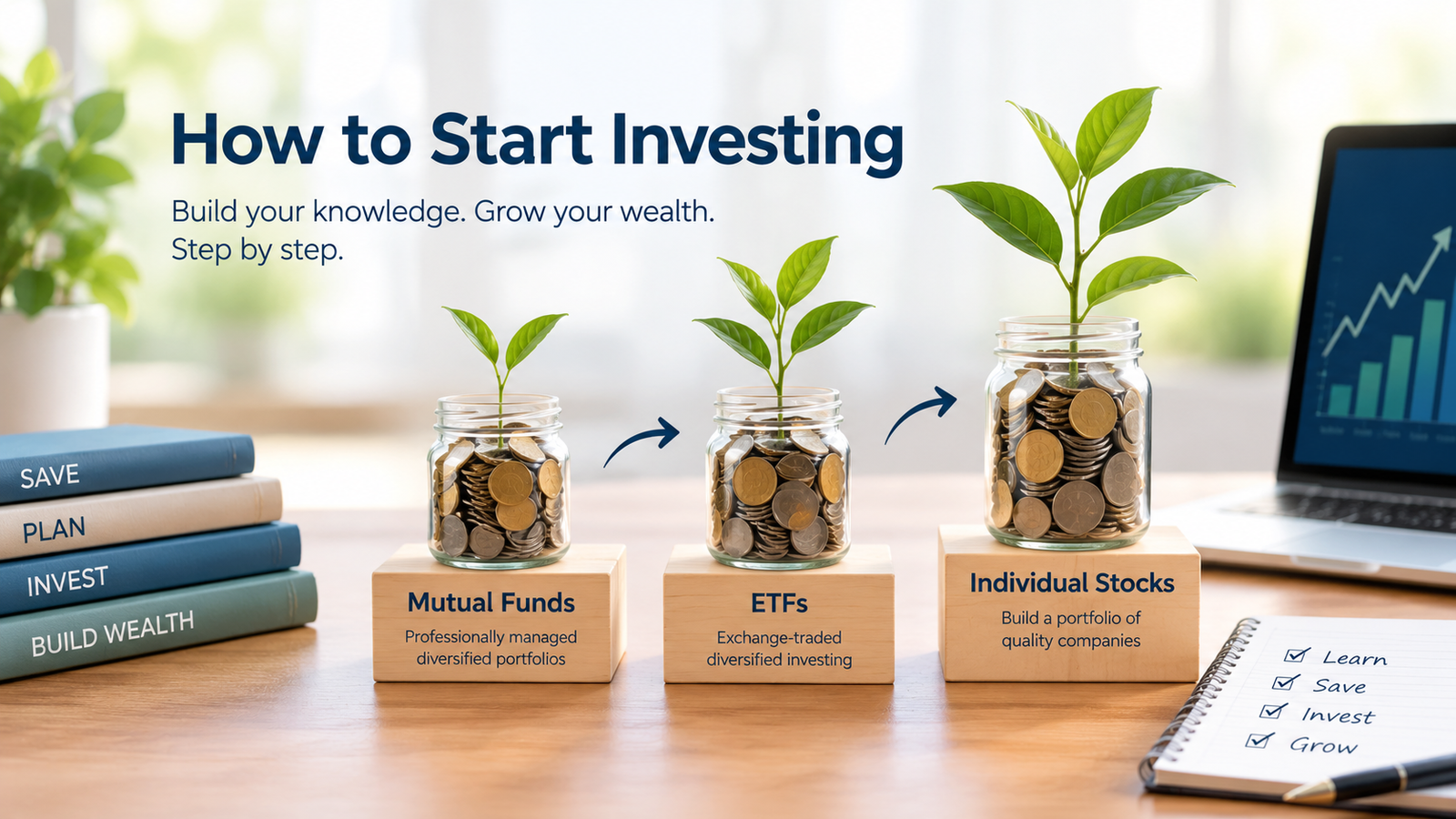
Rather than rushing into individual stocks, beginners can consider a three-stage approach: starting with mutual funds, exploring exchange-traded funds (ETFs), and eventually considering individual stocks as their knowledge and experience grow.
The goal is not to predict every market movement. It is to build consistent investing habits, understand risk, and make informed financial decisions over time.
How to Start Investing: Choosing Your First Investment
Many people enter the stock market with high expectations. They buy individual stocks, watch prices rise and fall, follow market news, and try to identify the next big opportunity. Yet, after experiencing a market downturn or seeing their investments remain stagnant for months, some become discouraged and sell their holdings at a loss.
Others begin to believe that investing is little more than speculation. They may even discourage friends and family from investing altogether.
But the problem is not necessarily the stock market itself. Sometimes, it is the way people begin their investment journey.
Successful investing is not just about choosing the right investment. It is also about developing the knowledge, discipline, patience, and emotional resilience needed to remain invested through different market conditions.
For beginners, a gradual approach can make the learning process more manageable. Rather than immediately buying individual stocks, you can begin with professionally managed investment funds, progress to exchange-traded funds (ETFs), and eventually consider building a portfolio of individual companies as your knowledge and experience develop.
This three-stage approach is not a requirement for every investor. It is a practical framework for people who want to build their investment knowledge progressively rather than taking on risks they do not yet understand.
Why Many Beginners Struggle With Direct Stock Investing
Stock markets move in cycles. Prices rise during bullish periods, decline during downturns, and sometimes remain within a narrow range for months while investors wait for a clearer direction.
A beginner may buy a stock near a temporary market peak, only to see its price fall shortly afterward. Another investor may buy during a market decline but become frustrated when the stock takes months to recover.
In both situations, the investor may begin questioning the original decision.
Without a clear investment strategy, even ordinary market movements can trigger emotional reactions. Investors may sell good investments prematurely, chase stocks that have already risen sharply, or switch strategies whenever market sentiment changes.
Several common problems contribute to these mistakes:
- Limited financial knowledge: Beginners may not understand company fundamentals, valuation, financial statements, or the factors that influence stock prices.
- Information overload: Financial news, social media commentary, price alerts, and market predictions can create constant distractions.
- Unrealistic expectations: Some investors expect quick profits without fully appreciating the possibility of losses.
- Poor risk management: Concentrating too much money in a few stocks can expose an inexperienced investor to significant losses.
- Emotional decision-making: Fear during market declines and excitement during rallies can undermine a long-term investment plan.
Direct stock investing can be appropriate for investors who have the necessary knowledge, time, and risk tolerance. However, beginners do not need to start there.
A more gradual approach can help them learn how investment products work, become familiar with market fluctuations, and develop consistent saving and investing habits.
Stage 1: Start With Mutual Funds
For many beginners, a diversified mutual fund can be a practical starting point.
A mutual fund pools money from multiple investors and invests it according to a defined investment objective. Depending on the fund, its portfolio may include stocks, bonds, money-market instruments, or other assets.
Some funds are actively managed by investment professionals, while others follow an index or a specified investment strategy.
Instead of selecting and monitoring individual companies yourself, you gain exposure to a portfolio managed according to the fund’s stated approach.
This can simplify the initial learning process, although it does not eliminate investment risk. Mutual funds can lose value, and their fees reduce investors’ net returns. <a href=”https://www.investor.gov/introduction-investing/investing-basics/investment-products/mutual-funds-and-exchange-traded-funds-etfs/mutual-funds”>Investor.gov’s guide to mutual funds</a> explains their structure, costs, and risks.
How to Begin With Mutual Funds
Start by reviewing your financial position. Make sure you have sufficient accessible savings for emergencies, understand your essential expenses, and have considered any high-interest debt before committing money to investments that can fluctuate in value.
Next, determine how much you can invest regularly without putting your financial stability at risk.
For example, a salaried person might begin by investing 5% of monthly income. Someone with greater financial flexibility might choose 10%, while another person may need to start with a smaller amount.
These percentages are illustrative, not universal rules. The appropriate contribution depends on your income, expenses, debt obligations, emergency savings, and goals.
You can then consider the following steps:
- Identify your investment goal and time horizon.
- Assess your risk tolerance and ability to absorb losses.
- Compare funds with appropriate investment objectives.
- Review the fund’s holdings, management approach, fees, taxes, and withdrawal conditions.
- Set up regular contributions that fit your budget.
- Review your statements periodically and track your returns after costs.
If your preferences include faith-based or ethical investing, you can also investigate funds that follow the relevant screening principles. Review the fund’s methodology and disclosures rather than relying solely on its label.
Before choosing an investment fund, understand its investment strategy, fees, diversification, and potential risks. The U.S. Securities and Exchange Commission’s investor education website provides useful explanations of mutual funds, exchange-traded funds (ETFs), and asset allocation and diversification.
Focus on the Process, Not Just the Return
Your first investment is an opportunity to learn.
Observe how your fund’s value changes over time. Understand the difference between your contributions and investment gains. Learn how management fees, taxes, distributions, and withdrawals affect the amount you actually retain.
For example, if you contribute 100 each month, the total amount you have invested after six months is 600. If your account value then stands at 615, that difference is not necessarily your final after-tax profit: any fees, distributions, taxes, and other cash flows must be accounted for.
You should also learn that returns are not guaranteed. A fund can perform well during one period and poorly during another, and past performance does not establish what it will earn in the future.
The purpose of this first stage is to build a repeatable habit and become comfortable with the mechanics of investing.
For additional guidance, see Equicio’s guide to investing for beginners and explore the investment return calculator to understand how investment performance can be measured.
Stage 2: Progress to Exchange-Traded Funds (ETFs)
Once you understand the basics of investing through mutual funds, you can consider exchange-traded funds as another way to access the financial markets.
An ETF pools investments into a fund whose shares trade on an exchange. Many ETFs track a market index, while others follow specific sectors, investment styles, or actively managed strategies.
Like mutual funds, ETFs can provide exposure to multiple securities through a single investment. However, their trading arrangements differ: ETF shares are generally bought and sold through a brokerage account at market prices during exchange trading hours.
This stage introduces you to the mechanics of exchange trading without necessarily requiring you to select individual companies.
Why ETFs Can Be Useful for Beginners
1. Exposure to multiple investments
A broad-market ETF can provide exposure to many companies through a single holding. This can reduce dependence on the performance of one company, although a narrowly focused ETF may still be highly concentrated.
2. An opportunity to learn about market prices
Because ETFs trade on exchanges, you can observe how their prices fluctuate during market hours and learn about bid-ask spreads, trading costs, and the relationship between market prices and the underlying value of a fund’s holdings.
3. A clearer view of portfolio composition
Reviewing an ETF’s factsheet and holdings can help you understand which companies, industries, regions, or asset classes contribute to its performance.
4. A potentially straightforward way to invest regularly
Depending on the ETF, brokerage, minimum investment requirements, and transaction costs, you may be able to purchase additional shares periodically as your savings grow.
Before investing, read the fund’s documentation and check its costs, holdings, trading liquidity, investment objective, and risks. An ETF is not automatically diversified, inexpensive, or suitable for every investor. <a href=”https://www.investor.gov/introduction-investing/investing-basics/investment-products/exchange-traded-funds-etfs”>Investor.gov’s ETF guide</a> provides further information.
Continue Investing While You Learn
You do not necessarily need to abandon mutual funds when you begin investing in ETFs. The two can serve different purposes within an overall portfolio.
For instance, you might retain a diversified mutual fund as a core holding while directing a portion of new contributions toward a suitable ETF. The proportions should reflect your financial goals, risk tolerance, investment horizon, and the overlap between the products.
Be careful not to assume that holding several funds automatically provides diversification. Two funds may own many of the same companies, giving you less diversification than you expect.
During this stage, focus on understanding the investments you own rather than constantly changing them in response to short-term market movements.
Stage 3: Consider Individual Stocks and Dividend Investing
After gaining experience with mutual funds and ETFs, some investors may wish to select individual companies directly.
This is a more demanding stage because you become responsible for assessing each company’s financial condition, competitive position, valuation, governance, and long-term prospects.
You should also be prepared to monitor developments that could materially affect the value of your holdings.
Look for Quality Before Chasing Returns
When assessing a company, consider factors such as:
- Financial strength: Review revenue, profitability, cash flow, debt, and the company’s ability to meet its obligations.
- Business quality: Understand how the company earns money, what gives it a competitive advantage, and whether its business model appears sustainable.
- Valuation: A strong company can still be a poor investment if its shares are purchased at an excessive price.
- Management and governance: Consider the quality of leadership, transparency, shareholder treatment, and capital-allocation decisions.
- Industry exposure: Understand the economic, regulatory, and competitive risks affecting the sector.
- Portfolio fit: Consider whether the stock adds useful diversification or increases exposure you already have elsewhere.
A company’s reputation alone is not enough. Neither a popular brand nor a history of rising share prices guarantees that its stock will deliver satisfactory future returns.
Build a Diversified Portfolio
One approach is to develop a watchlist of high-quality businesses across different industries and gradually build positions as your research and available capital allow.
For example, an investor might study businesses in consumer goods, healthcare, industrials, technology, and other sectors. The appropriate mix depends on the available opportunities, the investor’s goals, and the risks associated with each business.
There is no universal rule that every investor should own exactly nine companies. A small collection of individual stocks can remain concentrated even when the companies operate in different sectors. Diversification requires looking at the underlying businesses, their risk drivers, and the portfolio as a whole.
Investors with limited time or expertise may find that a broadly diversified fund remains more appropriate than selecting individual companies. Individual stock selection is an option to consider as your knowledge develops, not a compulsory stage everyone must reach.
Understand Dividend Investing
Dividend investing involves purchasing shares of companies that distribute part of their earnings or available cash to shareholders.
Dividends can provide a source of investment income, and reinvesting them can help compound returns over time. However, dividends are not guaranteed. A company may reduce or suspend its payments, and its share price may decline by more than the income it distributes.
A high dividend yield should not be treated as proof of a good investment. It can sometimes reflect a falling share price or financial difficulties.
When assessing a dividend-paying company, consider:
- The sustainability of its dividend payments.
- Its earnings and cash flow relative to dividends.
- Debt levels and future funding requirements.
- The company’s long-term growth prospects.
- Valuation and the total return potential.
- The tax treatment of dividends in your jurisdiction.
Total return matters more than dividend yield alone. Total return combines changes in the investment’s value with income received, taking account of relevant costs and taxes.
A dividend-focused portfolio can be part of a long-term strategy, but it should not replace careful company analysis and diversification.
How Should You Allocate Money Across These Three Stages?
There is no single allocation that suits everyone. Your investment mix should evolve according to your goals, financial circumstances, experience, and tolerance for losses.
One possible framework for someone who has already developed a reasonable financial foundation is to consider three broad categories:
| Investment category | Potential role |
|---|---|
| Mutual funds | A professionally managed or index-based foundation |
| ETFs | Exchange-traded exposure to selected markets or strategies |
| Individual stocks | Direct ownership in companies selected through research |
Some experienced investors may eventually choose to allocate roughly one-third of their investment portfolio to each category. However, this is only an illustrative framework—not a recommended allocation for every investor. It can create unnecessary overlap, and it may be unsuitable for someone whose goals call for a simpler or more conservative portfolio.
An investor who prefers a passive approach might use broad-market funds as the main component of the portfolio and hold few or no individual stocks. Another investor with the necessary expertise may choose a different mix.
What matters is that each holding has a clear purpose and that the combined portfolio has a level of risk you can realistically tolerate.
Review your allocation periodically and rebalance when appropriate, rather than making frequent changes because one category has recently outperformed another.
Invest Regularly and Avoid Trying to Time Every Market Move
A consistent investment habit can be more valuable than constantly searching for the perfect entry point.
One way to build this habit is through regular contributions, sometimes called dollar-cost averaging. Under this approach, you invest a fixed amount at regular intervals regardless of short-term price movements. You buy more units when prices are lower and fewer when prices are higher, although this does not guarantee a profit or prevent losses. <a href=”https://www.investor.gov/introduction-investing/investing-basics/glossary/dollar-cost-averaging”>Investor.gov’s explanation of dollar-cost averaging</a> provides further detail.
Regular investing can also reduce the temptation to wait indefinitely for an ideal market entry point.
However, invest only money that is appropriate for your goals and time horizon. Money needed soon for essential expenses or emergencies generally should not be exposed to substantial market volatility.
For a practical starting point, read Equicio’s guide to building wealth on an average salary.
How Long Does It Take to Become a More Confident Investor?
Investing knowledge develops through study, observation, and experience. It cannot be reduced to a fixed timetable.
You might spend your first year learning how funds work, understanding fees and taxes, and building a regular investment habit. During the following years, you could study ETFs, portfolio diversification, company financial statements, valuation, and dividend sustainability.
But time alone does not make someone an expert. A person who invests for several years without understanding the investments they own may still make avoidable mistakes. Another investor may develop a sound process sooner through careful study and disciplined practice.
Instead of treating three to five years as a guarantee of expertise, use that period as an opportunity to build your knowledge gradually.
At every stage, ask yourself:
- Do I understand what I own and why I own it?
- Can I explain the main risks of each investment?
- Do I know what fees and taxes affect my net returns?
- Am I diversified appropriately for my circumstances?
- Can I tolerate a significant temporary decline without abandoning my plan?
- Do I have a clear reason for buying, holding, or selling an investment?
If you cannot answer these questions about a particular investment, consider learning more before committing additional money.
Common Mistakes to Avoid When Starting to Invest
Even a gradual investment plan can fail if it is not supported by sound financial habits.
Investing before establishing financial stability: Build appropriate emergency savings and address expensive debt before exposing money needed for near-term obligations to market risk.
Chasing the latest trend: An investment that has performed exceptionally well recently may already be expensive or unsuitable for your objectives.
Ignoring fees and taxes: Small recurring costs can materially reduce long-term returns. Compare net performance rather than looking only at headline returns.
Assuming professionals always make better decisions: Fund managers have expertise and resources, but they can make mistakes, underperform benchmarks, and incur costs. Professional management does not guarantee superior performance.
Confusing diversification with safety: A diversified portfolio can still decline sharply during broad market downturns. Diversification reduces certain risks but cannot eliminate market risk.
Selling because of short-term volatility: Before reacting to a decline, revisit your original investment thesis, time horizon, and risk capacity. Do not hold an investment blindly, but do not abandon a sound long-term plan merely because prices have fallen.
Treating dividends as guaranteed income: Dividend payments can change, and a high yield may signal elevated risk.
Investing without a goal: A clear purpose helps determine the appropriate products, investment horizon, and level of risk.
Final Thoughts: Build Your Investing Journey Step by Step
Investing is a skill that develops over time. Just as people learn a sport or a professional discipline through instruction, practice, and experience, investors can improve their decisions by following a structured learning process.
For beginners, starting with a suitable diversified fund may make the first steps more manageable. ETFs can provide another way to access markets and study portfolio composition. Individual stocks and dividend investing can be considered later, when you are prepared to research businesses and accept the additional responsibilities involved.
You do not have to progress through all three stages. A well-chosen, diversified fund portfolio may meet your needs for years, or even for your entire investing journey.
The objective is not to own the most complicated portfolio or to outperform the market every year. It is to develop a sustainable process, understand the risks you are taking, and make decisions that support your long-term financial goals.
Start with an amount you can afford, invest consistently, keep learning, and allow your knowledge to grow alongside your capital.
Disclaimer: This article is for educational purposes only and does not constitute personalized financial, investment, tax, or legal advice. All investments carry risk, including the potential loss of principal. Consider your circumstances and consult a qualified professional when appropriate.