
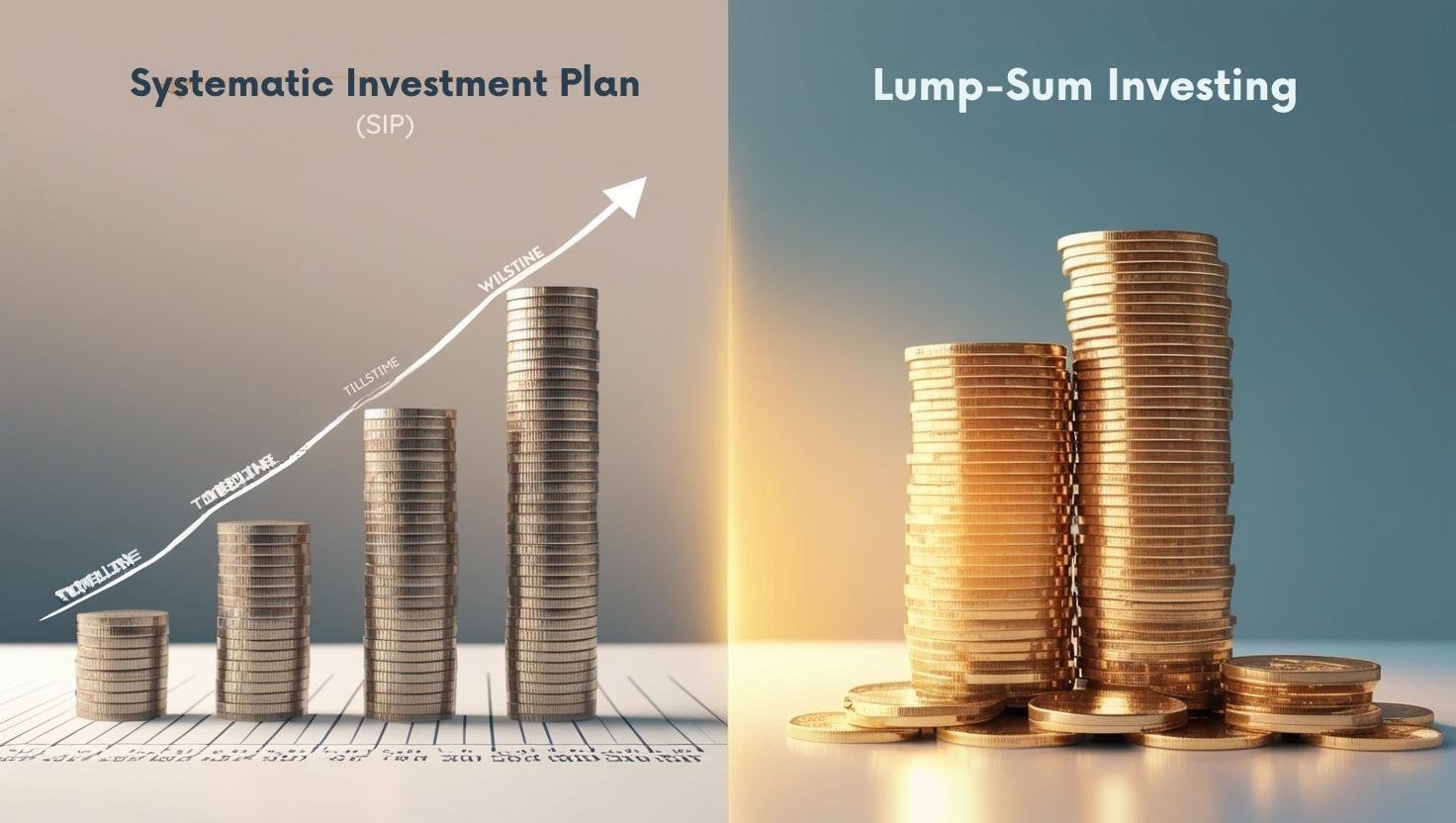
Lump sum vs monthly investing is an important decision for anyone looking to grow their money over time. Lump sum investing means investing a larger amount at once, while monthly investing involves contributing smaller amounts at regular intervals. Both approaches have advantages and risks, and the right choice depends on your available capital, investment horizon, risk tolerance and financial goals.
When comparing lump sum vs monthly investing, consider how much capital you already have, when you need the money, and how comfortable you are with market fluctuations. Lump sum investing puts available money to work immediately, whereas monthly investing spreads contributions over time. Your choice should reflect your financial goals, risk tolerance and investment horizon rather than short-term market predictions.
Lump Sum vs Monthly Investing: Key Differences
Suppose you have Rs.1 million available for investment.
Should you invest the entire amount immediately?
Or should you invest Rs.100,000 every month for the next 10 months?
This is a common question.
There is no universal answer.
The better choice depends on:
- Investment Horizon
- Market Conditions
- Risk Tolerance
- Liquidity Needs
- Financial Goals
- Existing Investments
- Behaviour and Discipline
The important thing is to understand the trade-off between investing immediately and spreading investments over time.
Ultimately, the choice between lump sum vs monthly investing depends on your circumstances. Investing a lump sum can provide greater market exposure from the outset, while monthly investing can help you build a consistent saving habit and spread your entry points over time. Neither strategy guarantees a profit or eliminates investment risk.
Before choosing an investment strategy, consider the relationship between risk and time horizon. The U.S. Securities and Exchange Commission’s Investor.gov provides educational resources to help investors understand investment risk, diversification and long-term investing.
What Is Lump-Sum Investing?
Lump-sum investing means putting a larger amount into an investment at one time.
For example:
Rs.1,000,000 today
The entire amount begins participating in the investment immediately.
If the investment rises after you invest, the full amount benefits from the increase.
But if the investment falls shortly afterward, the entire amount is exposed to that decline.
What Is Monthly Investing?
Monthly investing means spreading your investment over a series of contributions.
For example:
Rs.100,000 × 10 months = Rs.1,000,000
Instead of investing the entire amount immediately, you invest gradually.
This can reduce the risk of putting all your money into the market immediately before a decline.
But there is a trade-off.
Some of the money remains outside the investment for longer.
If markets rise during that period, the uninvested money does not participate in those gains.
The Main Difference Is Timing
Consider a simple example.
You have:
Rs.1 million
Strategy A
Invest Rs.1 million immediately.
Strategy B
Invest Rs.100,000 per month for 10 months.
Under Strategy A, the entire Rs.1 million is exposed from Day 1.
Under Strategy B, only part of the money is invested initially.
Therefore:
If markets rise strongly, lump-sum investing can benefit from earlier exposure.
If markets fall sharply soon after investing, gradual investing can reduce the amount exposed at the beginning.
Neither outcome is guaranteed.
Why Lump Sum Can Be Attractive
The biggest advantage of lump-sum investing is time in the market.
If you have already decided that the money is intended for a long-term investment, delaying investment means part of the capital is not working toward the objective.
Investor.gov highlights the role of time and regular investing in long-term wealth accumulation while also emphasizing that investments carry risk and market values fluctuate.
Why Monthly Investing Can Feel Easier
Investing a large amount at once can be psychologically difficult.
Imagine investing Rs.1 million today and seeing:
Rs.1,000,000 → Rs.900,000
within a short period.
You may feel that you made a terrible decision.
A gradual strategy can reduce the emotional impact of entering the market at one specific point.
This can be particularly useful for investors who are uncomfortable with short-term volatility.
But Monthly Investing Does Not Eliminate Risk
This is important.
Investing monthly does not guarantee a profit.
Markets can continue falling.
The strategy simply spreads the timing of purchases.
If the market falls for several months, later contributions may buy at lower prices.
But if the investment itself is poor, spreading purchases does not solve the underlying problem.
What About an Emergency Fund?
Before deciding how to invest a large amount, ask whether you actually need some of the money for short-term financial security.
Suppose you have:
Cash = Rs.1 million
Emergency requirement = Rs.600,000
Available long-term investment capital = Rs.400,000
It would make little sense to treat the entire Rs.1 million as long-term investment capital simply because you have it in your account.
Your [Emergency Fund Guide] explains why liquidity should be considered before investing.
What About Existing Debt?
If you have expensive debt, the investment decision should be considered alongside debt repayment.
Suppose you have:
Rs.1 million cash
Rs.1 million expensive outstanding debt
You should not automatically assume that the entire Rs.1 million should be invested.
Our article [Should I Invest or Pay Off My Loan First?] explores this decision in detail.
Consider Your Investment Horizon
A longer horizon generally gives you more time to tolerate market fluctuations.
For example:
Money needed in six months
Very different risk considerations.
Money needed in five years
More flexibility, but the goal still matters.
Retirement money needed in 20 years
Potentially much greater ability to tolerate short-term fluctuations.
Your time horizon should therefore influence the decision.
What About Market Timing?
One reason people prefer gradual investing is that it can reduce the pressure to identify the “perfect” entry point.
Suppose you invest Rs.1 million today.
You may spend the next six months wondering:
“Should I have waited?”
Gradual investing can reduce this psychological burden.
But there is an important trade-off:
Reducing timing risk can also reduce the benefit of immediate market exposure.
A Simple Illustration
Imagine Rs.1 million is available.
Lump sum
Rs.1 million invested immediately.
Monthly
Rs.100,000 invested each month.
If the market rises steadily during the 10 months, the lump-sum strategy will generally have more money invested during the earlier rise.
If the market falls immediately and then recovers, the monthly strategy may benefit from purchasing additional units at lower prices.
If the market moves sideways, the difference may be smaller.
If markets behave unpredictably, the result will depend on the sequence of returns.
What If You Already Have a Large Portfolio?
The decision is not only about the new money.
Suppose you already have:
Rs.5 million invested
and receive another:
Rs.1 million
Your existing asset allocation matters.
The new Rs.1 million could make one asset class too large if invested without considering the portfolio as a whole.
Our [Investment Return Calculator] can help with return scenarios, while your overall allocation should be considered separately.
Don’t Ignore Diversification
Whether you invest monthly or as a lump sum, diversification remains important.
Putting the entire amount into one highly concentrated investment creates a different risk from spreading it across appropriate investments.
The method of investing does not compensate for poor diversification.
Monthly Investing Can Create Discipline
One major advantage of regular investing is behavioural.
A fixed monthly contribution can turn investing into a habit.
For example:
Salary received → Rs.25,000 automatically invested
This removes the need to make a fresh decision every month.
Investor.gov describes regular investing as putting a set amount or percentage of income into investments and highlights the role of time and compounding in long-term investing.
What If You Are Nervous About Investing the Entire Amount?
You could consider a staged approach.
For example:
25% immediately
25% after one month
25% after two months
25% after three months
This is not a guarantee of better returns.
It is simply one possible behavioural approach for an investor who wants some immediate exposure without committing the entire amount on one day.
What Should You Avoid?
Avoid changing your strategy every time markets move.
For example:
Market rises → invest everything.
Market falls → stop investing.
Market rises again → invest again.
This can turn a simple strategy into emotional market timing.
A written plan can help.
A Practical Decision Framework
Consider lump-sum investing when:
- the money is genuinely long term
- your emergency fund is adequate
- expensive debt is under control
- you understand the investment
- your risk tolerance is appropriate
- you can tolerate short-term volatility
Consider gradual investing when:
- you are uncomfortable investing the entire amount at once
- you want to reduce timing concentration
- regular investing helps you maintain discipline
- the money can remain available during the investment period
These are not rigid rules.
The Most Important Question
Don’t ask only:
“Which strategy gives the highest return?”
Ask:
“Which strategy can I follow consistently without making emotional decisions?”
A theoretically superior strategy is not useful if you abandon it during the first market decline.
Practical Takeaway
Lump-sum investing gives your money immediate market exposure.
Monthly investing spreads the timing of your purchases.
Lump sum can benefit when markets rise after investment.
Gradual investing can reduce the impact of entering immediately before a decline.
Neither strategy guarantees success.
The more important principles are:
Have an emergency reserve.
Control expensive debt.
Know your investment horizon.
Understand your risk tolerance.
Diversify appropriately.
Invest consistently.
Avoid emotional decisions.
If you have a large amount available, there is nothing wrong with taking some time to create a clear plan before investing it.
Related Equicio Guides and Tools
- SIP Calculator
- Investment Return Calculator
- Compound Interest Calculator
- Investing for Beginners
- Lessons from Investing in Stocks
- Emergency Fund
- Should I Invest or Pay Off My Loan First?
- Financial Tools and Calculators
Disclaimer
This article is for general educational purposes and does not constitute personalized investment advice. Investment values can rise or fall, and past performance does not guarantee future results. The appropriate investment strategy depends on your financial position, goals, time horizon, risk tolerance and circumstances.