
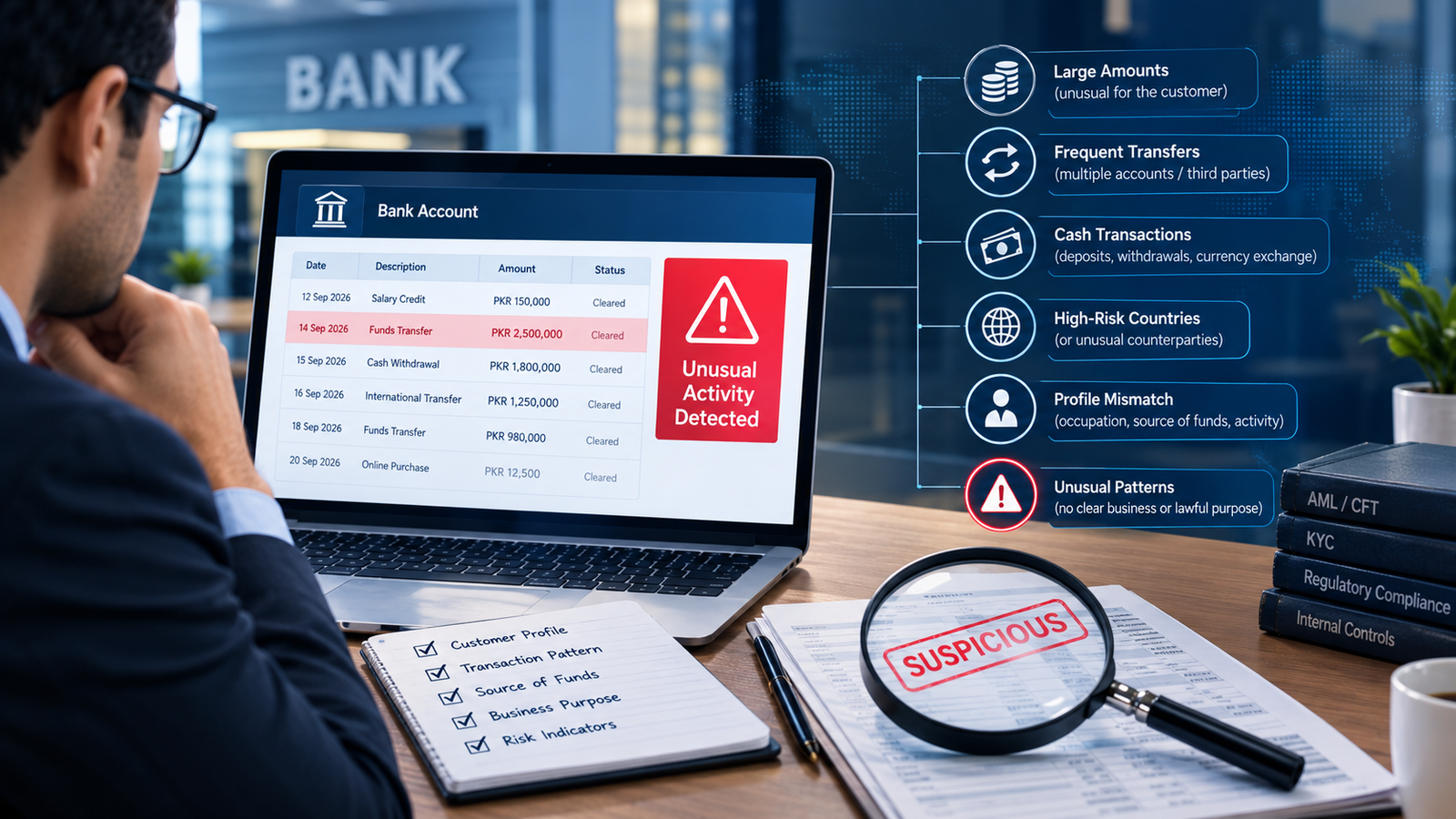
What makes a bank transaction look suspicious is usually not the transaction amount alone. A transaction may attract attention when it does not appear consistent with the customer’s known profile, normal account activity, stated source of funds or expected business purpose.
This does not mean that an unusual transaction automatically means money laundering or financial crime. Banks have to consider the circumstances surrounding a transaction, the customer’s background, the account history and the explanation or supporting information available before deciding whether further review is necessary.
In Pakistan, banks and other regulated entities operate within the anti-money laundering, combating the financing of terrorism and countering proliferation financing framework issued under applicable law and regulatory requirements. The State Bank of Pakistan requires regulated entities to maintain appropriate customer due diligence, risk assessment and transaction-monitoring arrangements. SBP AML/CFT/CPF Regulations
What Makes a Bank Transaction Look Suspicious? Key Factors
A transaction may look suspicious when it is unusual, inconsistent with the customer’s established profile, lacks an apparent lawful or economic purpose, or forms part of a pattern that raises reasonable questions.
The key point is that context matters.
For example, a large credit into an account is not necessarily suspicious simply because the amount is large. The same transaction may be entirely reasonable if the customer has sold a property and can provide the relevant documentation.
On the other hand, repeated large credits into an account belonging to a salaried employee, followed by immediate transfers to unrelated third parties, may require further examination if the activity cannot reasonably be explained by the customer’s known circumstances.
Banks therefore look beyond individual transactions and consider the broader relationship.
Customer Profile and Transaction Profile
One of the most important concepts in transaction monitoring is the relationship between the customer profile and the transaction profile. Understanding what makes a bank transaction look suspicious requires looking at the relationship between the customer’s known circumstances and the activity taking place through the account.
When a customer opens a bank account, information is collected about matters such as:
- Occupation or nature of business
- Expected source of funds
- Expected account activity
- Nature and purpose of the relationship
- Geographic or business connections
- Expected transaction volumes and values
This information contributes to the customer’s risk and transaction profile.
The customer’s actual account activity can then be compared with what the bank understands about the customer.
For example, consider a customer who declares that they are a salaried employee earning a regular monthly salary. If the account subsequently receives numerous high-value business-related payments every day, followed by transfers to multiple unrelated persons, the activity may be inconsistent with the information available to the bank.
That does not automatically establish wrongdoing. It does, however, create a reason for the bank to understand what is happening.
This is why accurate and updated KYC information is important.
Transactions That Do Not Make Economic Sense
Older SBP guidance on suspicious transactions specifically highlighted complex, unusually large transactions and unusual patterns that have no apparent economic or lawful purpose. The examples were expressly described as non-exhaustive and intended as an aid rather than a mechanical checklist.
Examples of activity that may require increased scrutiny include:
1. Frequent transfers between multiple accounts
A customer may maintain several accounts for legitimate reasons. However, extensive movement of funds between numerous accounts without a clear business or personal purpose may require explanation.
2. Immediate withdrawal after deposit
Funds that are deposited and withdrawn almost immediately may attract attention where the customer’s normal business activities do not provide a reasonable explanation for the pattern.
3. Previously inactive accounts becoming highly active
An account that has remained largely inactive for a long period but suddenly begins receiving and transferring substantial amounts may require review.
The important point is not simply that the account became active. The bank may need to understand why the activity changed and whether it is consistent with the customer’s circumstances.
4. Transactions inconsistent with the customer’s business
A customer’s transactions should generally make sense when viewed against the nature of their occupation or business.
For example, trade-finance transactions involving countries, products or counterparties that have no apparent connection with the customer’s established business may require additional scrutiny.
5. Unexpected repayment of overdue financing
An overdue facility that is suddenly repaid without a plausible explanation regarding the source of the funds may generate questions, particularly where the repayment is inconsistent with the customer’s known financial circumstances.
6. Back-to-back financing arrangements
Financing arrangements involving related or third parties that have no identifiable and legitimate economic purpose may warrant closer examination.
These examples do not mean that any one of these circumstances proves money laundering. They are indicators that may need to be considered together with other information.
Large Cash Transactions
Cash activity can also attract increased scrutiny when it is unusual for the customer or inconsistent with the customer’s profile.
Examples may include:
- Repeated large cash deposits without an apparent business reason
- Frequent large cash withdrawals
- Converting unusually large quantities of small-denomination notes into higher denominations
- Substantial cash foreign-exchange transactions where the customer normally operates through an account
- Cash activity substantially different from the customer’s previous pattern
A cash-intensive business may naturally conduct significant cash transactions. A salaried individual with little historical cash activity may require a different assessment.
The customer’s occupation, business model, account history and supporting information therefore remain important.
A Dormant or Inactive Account Suddenly Becomes Active
An account that has remained inactive for a considerable period and suddenly begins receiving large amounts and conducting high-value transfers can attract attention.
For example, suppose an account has historically shown only occasional personal expenses. It then begins receiving several large credits and transferring most of the money to different beneficiaries within a short period.
The bank may need to understand:
- Where did the money come from?
- Why has the account activity changed?
- Who are the counterparties?
- What is the purpose of the transfers?
- Does the activity match the customer’s occupation and stated source of funds?
- Is there supporting documentation?
Again, unusual activity is a reason for examination, not proof of criminal conduct.
Transactions Involving Higher-Risk Countries or Jurisdictions
International transactions may also receive additional attention where they involve jurisdictions, counterparties or activities presenting higher money-laundering or terrorist-financing risks.
However, a transaction involving a particular country should not automatically be treated as suspicious.
The bank may consider the customer’s business, the purpose of the transaction, the counterparties, the nature of the goods or services, the source and destination of funds and other relevant risk factors.
A legitimate international business transaction can therefore look very different from an unexplained transfer involving the same jurisdiction.
Unusual Does Not Automatically Mean Suspicious
This is one of the most important points for customers to understand.
A transaction can be:
Unusual → reviewed → explained → accepted
It does not necessarily become:
Unusual → suspicious → criminal
For example, a customer may receive a large amount because of:
- Sale of property
- Inheritance
- Retirement benefits
- Sale of a vehicle or business
- Investment redemption
- Loan proceeds
- Business expansion
- A genuine commercial transaction
If the transaction is legitimate and the customer can reasonably explain and support it, the bank may be able to understand the reason for the unusual activity.
This is why customers should not assume that a request for information means that the bank has accused them of wrongdoing.
Why Banks Ask Questions About Unusual Transactions
When transaction activity does not match the information available to the bank, staff or the bank’s monitoring systems may seek additional information.
Questions may relate to:
- Source of funds
- Purpose of transaction
- Relationship with the counterparty
- Nature of business
- Expected transaction volume
- Supporting documents
- Reason for a sudden change in account activity
The objective is to understand whether the activity is consistent with the customer’s profile and whether the bank has sufficient information to satisfy its regulatory and internal requirements.
SBP’s AML/CFT/CPF framework requires regulated entities to maintain appropriate systems and controls for identifying and managing financial-crime risks. SBP has also directed regulated entities to use transaction-monitoring arrangements capable of identifying unusual or out-of-pattern activity for further assessment.
What If the Customer’s Information Is Outdated?
Sometimes the transaction is legitimate but the customer’s information with the bank is no longer accurate.
For example, a customer may have originally opened an account as a salaried employee but later started a business.
If the bank still has the old occupation and expected transaction profile, the customer’s current activity may appear unusual.
In such circumstances, updating KYC information can help the bank understand the customer’s current circumstances.
Persistent unusual trends may therefore lead to a request to update customer information or provide additional supporting documents.
SBP’s customer-onboarding framework sets out information and documentary requirements for establishing customer relationships, while AML/CFT/CPF requirements apply to ongoing customer due diligence and monitoring.
Infrequent Unusual Transactions vs Persistent Unusual Activity
There is an important difference between an occasional unusual transaction and a persistent pattern.
An infrequent unusual transaction
A customer may occasionally receive a large amount because of a property sale, inheritance or other legitimate event.
The transaction may initially look unusual, but supporting information may provide a reasonable explanation.
Persistent unusual activity
A continuing pattern of transactions that repeatedly differs from the customer’s known profile may require more detailed examination.
For example:
A salaried customer normally receives one monthly salary but begins receiving multiple high-value credits every week, immediately transferring much of the money to unrelated persons.
The issue is not simply the size of one transaction. It is the pattern, its consistency with the customer’s profile and whether there is a reasonable explanation.
What Transaction-Monitoring Systems Look For
Modern banks do not rely only on branch staff manually noticing unusual activity.
Banks use transaction-monitoring systems and other controls to identify transactions or patterns that may require investigation.
These factors help banks assess what makes a bank transaction look suspicious and whether an unusual pattern requires further review.
Depending on the bank and the nature of the relationship, monitoring may consider factors such as:
- Transaction amount
- Frequency
- Transaction velocity
- Cash activity
- Geographic activity
- Counterparties
- Beneficiary relationships
- Changes from historical behaviour
- Customer risk profile
- Expected transaction activity
- Unusual combinations of transactions
SBP regulations require banks and DFIs to maintain appropriate transaction-monitoring arrangements, including automated monitoring capable of generating meaningful alerts based on customer profiles and defined parameters.
The resulting alert is not itself a finding of money laundering. It is generally a trigger for further analysis.
What Happens When a Transaction Generates an Alert?
A transaction-monitoring alert may be reviewed by the relevant bank staff or AML/compliance function.
Depending on the circumstances, the bank may:
- Review the customer’s profile.
- Examine the account history.
- Review related transactions.
- Understand the purpose and background of the activity.
- Request additional information or documents where appropriate.
- Document the analysis and findings.
- Decide whether the matter requires further action.
The review should therefore be viewed as an analytical process rather than an automatic conclusion.
Suspicious Transaction Reporting
Where a reporting entity forms the required suspicion under applicable law, a Suspicious Transaction Report (STR) may need to be submitted to Pakistan’s Financial Monitoring Unit (FMU).
The FMU receives and analyses STRs and CTRs and may disseminate relevant financial intelligence to appropriate investigating, prosecuting, regulatory or supervisory authorities in accordance with the law.
Current FMU guidance states that suspicious transaction activity is to be reported promptly, with current guidance also specifying a seven-working-day outer limit after the suspicion is formed. This is different from older SBP material that referred to a three-day reporting process to the State Bank.
For this reason, older regulatory documents should not be treated as the current reporting procedure without checking the latest applicable requirements.
The FMU’s current resources include STR reporting forms, suspicious-transaction guidance and sector-specific red-flag material. FMU reporting forms and guidance
Banks Must Not Treat Every Red Flag as Proof of Crime
Suspicious-transaction indicators are designed to help identify activity that deserves attention.
They are not intended to be used as a mechanical checklist where one indicator automatically means that a customer is involved in money laundering.
The circumstances surrounding the activity matter.
A transaction may have a perfectly legitimate explanation. Conversely, several individually ordinary transactions may become concerning when viewed together as part of a wider pattern.
This is why transaction monitoring involves analysis rather than simply looking at transaction amounts.
Why Accurate Information Matters
Customers can make the bank’s review process easier by keeping their information updated and providing genuine explanations when requested.
If your occupation, business, source of income or expected account activity changes, it is sensible to consider whether your bank’s records should also be updated.
Incomplete, inaccurate or misleading information can make it more difficult for the bank to understand legitimate transactions.
Where a bank requests documents, customers should provide genuine and relevant information rather than attempting to construct an explanation after the transaction has already occurred.
A Practical Example
Consider two customers who each receive PKR 5 million into their bank accounts.
Customer A
Customer A is a businessman whose bank records show substantial commercial activity. The customer receives PKR 5 million from a known business counterparty and provides appropriate documentation explaining the transaction.
The amount is large, but the transaction may be consistent with the customer’s profile and business.
Customer B
Customer B is a salaried employee with a regular monthly salary and historically modest account activity.
The account suddenly receives several unrelated high-value credits, followed by rapid transfers to different individuals. There is no obvious connection between the activity and the customer’s known occupation or expected source of funds.
The same PKR 5 million amount can therefore produce a very different compliance question.
The important factor is context and transaction pattern, not simply the number appearing in the account.
What Customers Can Do
Customers can reduce unnecessary difficulty by:
- Keeping KYC information updated
- Providing accurate occupation and business information
- Clearly understanding their declared source of funds
- Keeping documents supporting significant legitimate transactions
- Responding accurately when the bank asks reasonable questions
- Avoiding unnecessary use of an account for third-party transactions
- Avoiding unexplained movement of funds through personal accounts
- Keeping proper records of major financial transactions
These practices do not guarantee that a transaction will never be reviewed. Banks have regulatory and risk-management responsibilities, and legitimate transactions can still require clarification.
The Practical Banking Perspective
From a practical banking perspective, understanding what makes a bank transaction look suspicious starts with a simple question:
“Does this transaction make sense when compared with what we know about the customer?”
That question leads to several others:
- What is the customer’s occupation or business?
- What is the expected source of funds?
- What transaction pattern is normally expected?
- Is the amount reasonable in the circumstances?
- Who is sending or receiving the money?
- What is the purpose of the transaction?
- Has the customer’s activity recently changed?
- Is there a reasonable and verifiable explanation?
- Does the available information support that explanation?
The objective is not to treat every unusual transaction as suspicious. It is to identify situations where the available information does not adequately explain the activity and where further assessment may therefore be necessary.
In simple terms, what makes a bank transaction look suspicious is usually the combination of unusual activity, an inconsistent customer or transaction profile, an unclear purpose and the absence of a reasonable explanation.
Related Equicio Guides
You may also find these Equicio guides useful:
- Fraud Warning Signs: How to Identify Financial Fraud
- How to Detect Financial Fraud: Warning Signs and Prevention
- Anti-Money Laundering (AML): A Practical Guide for Bankers
- Why Banks Ask About the Source of Funds
- Banking: Practical Guides to Accounts, Loans & Digital Banking
- Financial Tools & Calculators
Official Regulatory Resources
For readers who want to go beyond this practical explanation, the following official resources provide further information:
- State Bank of Pakistan — Laws and Regulations
- Financial Monitoring Unit — STR Reporting Forms and Guidance
- Financial Monitoring Unit — Regulations and Guidelines
Disclaimer
This article is provided for general educational and informational purposes. It explains common banking and AML/CFT concepts and does not determine whether any particular transaction, customer or activity is suspicious or unlawful.
Regulatory requirements may change, and banks may apply additional internal policies and risk-management procedures. For a specific regulatory, legal or financial matter, readers should consult the applicable legislation, regulator or qualified professional.
2 thoughts on “What Makes a Bank Transaction Look Suspicious?”
Comments are closed.