
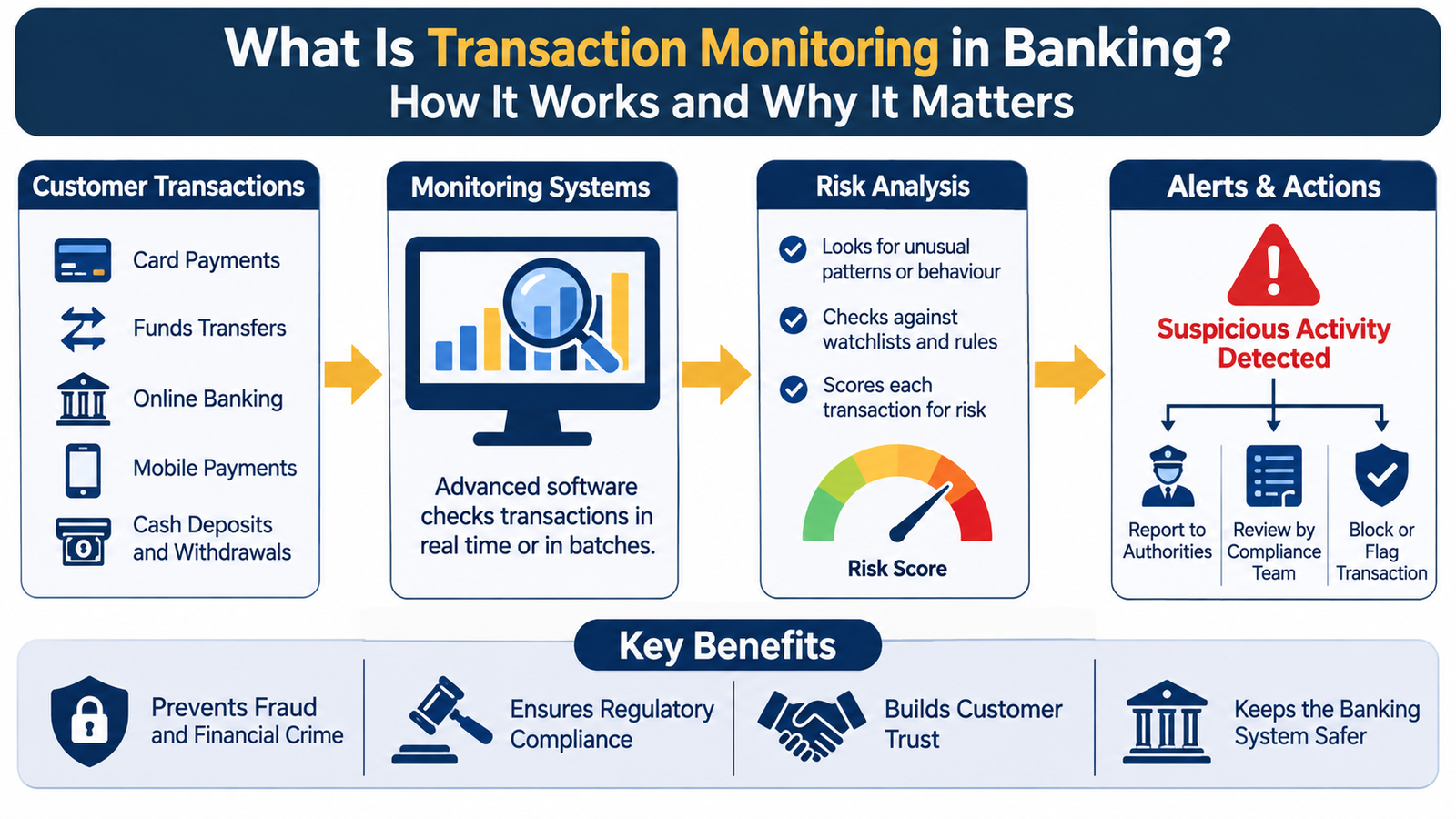
Transaction monitoring in banking is the process of reviewing customer transactions to identify unusual patterns, activity inconsistent with a customer’s known financial profile, or transactions that may indicate money laundering, terrorist financing, fraud, or other financial crime.
Banks use transaction monitoring as an important part of their anti-money laundering (AML) and financial crime prevention frameworks. It helps financial institutions identify activity that may require further investigation and, where appropriate, regulatory reporting.
Monitoring can involve automated systems, manual reviews, employee referrals, or a combination of these methods. However, an alert does not automatically mean that a transaction is suspicious. It identifies activity that needs to be assessed in context.
Why Is Transaction Monitoring Important?
Banks process large volumes of deposits, withdrawals, transfers, card payments, and other financial transactions every day. Reviewing every transaction manually would be difficult and inefficient.
Transaction monitoring helps institutions identify activity that may require closer attention.
Its main objectives include:
- Identifying unusual or potentially suspicious transactions.
- Detecting patterns that may indicate money laundering or terrorist financing.
- Comparing actual account activity with the customer’s expected financial profile.
- Supporting fraud prevention and other financial crime controls.
- Identifying changes in customer behaviour that may require a risk reassessment.
- Supporting the investigation and reporting of suspicious activity where required.
The Financial Conduct Authority’s guidance on ongoing monitoring explains that firms should scrutinise transactions to ensure they are consistent with what they know about the customer and keep relevant customer information up to date.
How Does Transaction Monitoring in Banking Work?
Transaction monitoring in Banking generally involves several connected stages.
1. Establishing the Customer Profile
Before a bank can identify unusual activity, it needs a reasonable understanding of the customer.
This information may include:
- Occupation or nature of business
- Expected income and account turnover
- Source of funds
- Purpose of the account
- Expected transaction volumes and values
- Countries or regions from which payments are expected
- Customer risk classification
This information is developed through customer due diligence and ongoing reviews. For more information, read our guide on banking compliance roles and responsibilities.
2. Monitoring Transactions in Banking
Banks review transactions using automated systems, manual reports, employee referrals, or a combination of methods.
Monitoring parameters may consider:
- Transaction amount and frequency
- Cash deposits and withdrawals
- Domestic and international transfers
- Multiple transactions occurring within a short period
- Transactions involving higher-risk locations
- Activity inconsistent with the customer’s established profile
- Unusual changes in account balances or turnover
The monitoring approach should reflect the institution’s risk profile, products, services, customers, and geographic exposure.
3. Generating Alerts
When a transaction or pattern meets defined monitoring criteria, the system may generate an alert for review.
For example, a personal account that normally receives a regular salary may suddenly begin receiving frequent high-value deposits from unrelated parties.
The system may flag this activity because it differs from the expected account profile.
An alert is an indication for further assessment, not proof of wrongdoing.
4. Investigating Alerts
The bank’s designated staff review the alert and relevant customer information to determine whether the activity has a reasonable explanation.
The review may involve:
- Examining the transaction history.
- Comparing activity with the customer’s known profile.
- Reviewing related accounts or counterparties where permitted.
- Seeking clarification or supporting documents from the customer.
- Considering the purpose and economic rationale of the transactions.
- Recording the investigation and its outcome.
For a broader explanation of unusual account activity, see what makes a bank transaction look suspicious.
5. Escalation and Reporting
If the investigation identifies reasonable grounds for suspicion under the applicable legal framework, the matter may be escalated to the bank’s AML or compliance function.
The institution then considers whether a suspicious transaction or activity report must be submitted to the relevant financial intelligence unit or authority.
Reporting requirements and deadlines vary by jurisdiction. Banks should also maintain appropriate confidentiality and avoid disclosing restricted reporting information to customers.
The FFIEC BSA/AML Examination Manual describes the components of an effective suspicious activity monitoring and reporting process, including alert identification, alert management, reporting decisions, and ongoing monitoring.
Common Transaction Monitoring Red Flags
Transaction monitoring systems may be designed to identify a range of patterns that require further examination.
Examples include:
Frequent Cash Deposits
Repeated cash deposits that are inconsistent with a customer’s occupation or declared business activity may require clarification.
Multiple Small Transactions
A series of transactions may be reviewed when the pattern appears designed to avoid reporting requirements or conceal the true scale of activity. The context and applicable legal thresholds matter.
Unusual International Transfers
Payments involving unexpected destinations, counterparties, or transaction patterns may warrant further review.
Rapid Movement of Funds
Money entering an account and being transferred out shortly afterwards, particularly through several unrelated accounts, may require an explanation.
Activity Inconsistent With the Customer Profile
A personal account showing substantial business-related turnover, or a dormant account suddenly handling significant transaction volumes, may require reassessment.
Unexplained Third-Party Transactions
Frequent payments from unrelated individuals or entities may be inconsistent with the customer’s stated purpose for maintaining the account.
These are indicators for review, not automatic proof of money laundering or other illegal activity.
Manual vs Automated Transaction Monitoring
Banks may use manual and automated monitoring approaches depending on their size, transaction volumes, products, and risk exposure.
| Area | Manual monitoring | Automated monitoring |
|---|---|---|
| Method | Staff review reports and transactions | Software analyses transaction data using rules, models, or other logic |
| Scale | Suitable for selected reports or lower-volume activities | Can process large transaction volumes |
| Alert generation | Reports, referrals, and employee observations | System-generated alerts |
| Human involvement | High during initial review | Required for investigation and decisions |
| Main limitation | Time-consuming and dependent on staff capacity | Depends on data quality, scenarios, thresholds, and system effectiveness |
Many institutions use a combination of both approaches. Automated systems can identify patterns at scale, while trained staff assess the circumstances and determine the appropriate response.
Challenges in Transaction Monitoring in Banking
An effective monitoring framework requires more than purchasing software or setting transaction thresholds.
Common challenges include:
False positives: Systems may generate alerts for legitimate transactions, creating unnecessary investigation work.
False negatives: Poorly designed scenarios, incomplete data, or inappropriate thresholds may fail to identify relevant suspicious activity.
Data quality: Incorrect customer information or incomplete transaction records can weaken monitoring effectiveness.
Outdated rules: Criminal methods and customer behaviour change. Monitoring scenarios and parameters therefore need periodic review.
Investigation backlogs: Insufficient staffing, unclear procedures, or inefficient alert handling can delay investigations.
The FCA has highlighted weaknesses involving risk assessments, monitoring scenarios, system parameters, and data quality in its financial crime guidance.
What Makes an Effective Transaction Monitoring Framework?
An effective framework should be risk-based, properly governed, and subject to ongoing review.
Important elements include:
- Risk-based monitoring: Monitoring scenarios should reflect the institution’s customers, products, services, and geographic exposure.
- Appropriate parameters: Thresholds and rules should be supported by a documented rationale.
- Reliable data: Customer and transaction information should be accurate and sufficiently complete.
- Effective alert management: Alerts should be prioritised, investigated, documented, and escalated appropriately.
- Adequate staffing and training: Employees should understand their responsibilities and escalation procedures.
- Independent testing: Monitoring systems and processes should be assessed to determine whether they operate as intended.
- Regular review: Scenarios, thresholds, and system effectiveness should be reassessed as risks change.
Final Thoughts
Transaction monitoring in Banking is a central component of banking compliance and financial crime prevention. It enables financial institutions to review transaction activity, identify unusual patterns, and investigate activity that may require further attention.
However, effective monitoring depends on more than automated alerts. Accurate customer profiles, appropriate risk-based scenarios, sound investigation procedures, trained staff, and effective escalation are all essential.
Ultimately, the objective is not to flag every unusual transaction as suspicious. It is to identify relevant risks, assess them fairly, and take appropriate action in accordance with applicable legal and regulatory requirements.